
What is an ideal customer profile? (With examples)
What an ICP is, what goes in it, and five examples you can adapt for your own business.
An ideal customer profile (ICP) describes the type of company that gets the most value from what you sell. It is about companies, not people.
A good ICP tells you who to look for and who to skip. That makes every list, email and call more focused.
ICP vs buyer persona
These two are often mixed up. The ICP picks the company. The buyer persona picks the person inside it.
| Ideal customer profile | Buyer persona | |
|---|---|---|
| Describes | A type of company | A type of person |
| Answers | Which companies should we sell to? | Who at the company do we talk to? |
| Example | US software companies with 21 to 250 employees | A Head of Marketing who owns the lead target |
What goes into an ICP
Keep it to five parts. Each one should be something you can check.
- Industry. What kind of business they are, such as software, healthcare or retail.
- Size. The number of employees or yearly revenue.
- Location. The countries or cities you can sell to and support.
- Reason to buy. A problem you solve, or a sign they have it right now.
- Not a fit. Companies that look right but rarely buy. Write these down too.
How to write your ICP in four steps
- List your best customers. Pick 5 to 10 who bought quickly, stayed and were easy to work with.
- Find what they share. Compare industry, size and location first. Then look for a shared problem.
- Note who didn't fit. Lost deals and unhappy customers show you what to leave out.
- Write it as one short paragraph. Use the template below.
Our ideal customers are [industry] companies with [size] employees in [location]. They usually [sign they need us]. They buy because [problem we solve]. We don't target [companies to leave out].
No customers yet? Start with the companies you understand best. Then update your ICP after your first 10 to 20 sales conversations.
Five ICP examples
Each example uses the same five parts. Start from the one closest to your business.
Marketing agency selling SEO
- Industry
- Software and online services
- Size
- 11 to 100 employees
- Location
- United States and Canada
- Reason to buy
- Recently raised money and needs more leads
- Not a fit
- Companies with their own SEO team
Cybersecurity consultancy
- Industry
- Financial services and healthcare
- Size
- 101 to 1,000 employees
- Location
- United Kingdom
- Reason to buy
- Must pass security checks to win bigger clients
- Not a fit
- Companies with a full in-house security team
HR and payroll software
- Industry
- Manufacturing, retail and services
- Size
- 21 to 250 employees
- Location
- India
- Reason to buy
- Still runs payroll in spreadsheets
- Not a fit
- Companies already using a large HR system
Tech recruiting agency
- Industry
- Software development
- Size
- 101 to 500 employees
- Location
- Germany and the Netherlands
- Reason to buy
- Has several open engineering jobs
- Not a fit
- Companies with a large in-house recruiting team
Commercial cleaning company
- Industry
- Offices, clinics and schools
- Size
- 21 to 250 employees
- Location
- Within 30 miles of your base
- Reason to buy
- Just moved offices or unhappy with their cleaner
- Not a fit
- Home-based and shared-office businesses
Turn your ICP into a search
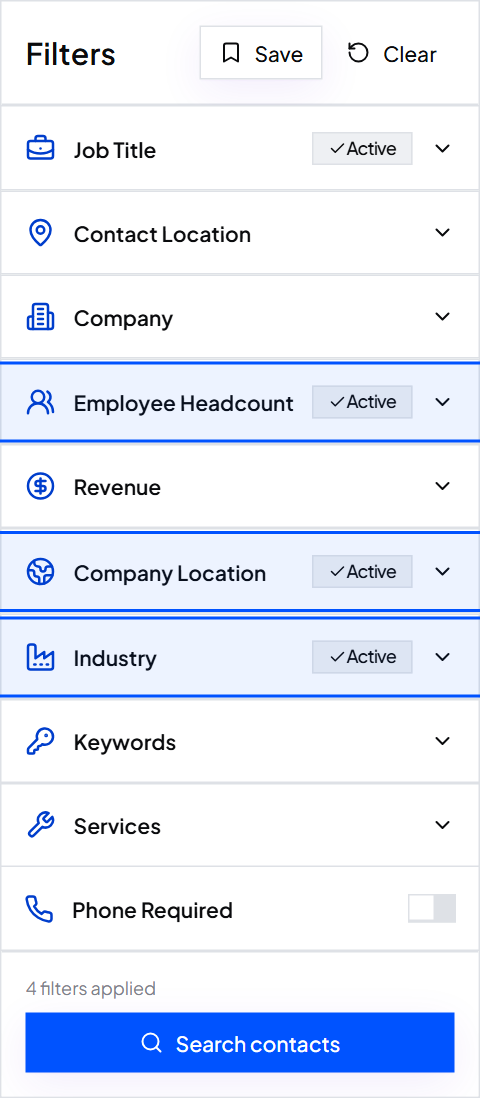
Each part of your ICP matches a filter in ContactYard. Add your buyer persona as job titles, and you have a list.
| ICP part | Filter to use |
|---|---|
| Industry | Industry |
| Size | Employee Headcount or Revenue |
| Location | Company Location |
| Specialty or niche | Keywords |
| Who to contact | Job Title |
| Not a fit | Exclude job titles, and leave those options out |
The takeaway
Keep your ICP short, specific and easy to check. Review it every few months as you learn who really buys.
Ready to use it? Build a prospect list from your ICP.
Keep reading
How to build a prospect list that gets replies
Six steps to go from a rough idea of your buyer to a short list of people worth emailing.
How to personalize cold emails with AI using company websites
Let AI read each prospect's website and write a short, specific first line. Includes prompts you can copy.