
What your best customers have in common (and how to find more)
Look at your ten best customers, spot the traits they share and turn those traits into a search that finds similar companies.
Your best customers already tell you who to target. The trick is to look at them side by side, spot what they share and ignore what only seems important.
This guide takes about an hour. It's a practical way into the broader ideal customer profile work.
Step 1: Choose the ten best, with a clear definition
Decide what “best” means before you pick. For most teams it's some mix of these:
- They stayed a long time.
- They paid more than average.
- They buy more over time.
- They need little help from support.
Step 2: Record the same facts for each
Use one row per customer and fill in the same columns. Stick to facts you can look up:
| Column | Why it matters |
|---|---|
| Industry | Tells you where to search |
| Headcount band | Matches ContactYard's headcount filter |
| Country or region | Matches the location filters |
| Who bought (job title) | Matches the job title filter |
| What triggered the purchase | Helps your message, not the search |
Step 3: Find the traits at least 7 of 10 share
Look for patterns in the columns. A trait that appears in seven of ten rows is worth using. A trait in three of ten is a coincidence.
Fictional example: ten customers of a payroll tool
- Industry
- 8 of 10 are in construction or trades
- Headcount
- 9 of 10 have 20 to 80 staff
- Buyer
- 7 of 10 were bought by an office manager
- Country
- Spread across five, so don't filter on this
Step 4: Turn the shared traits into a search
Enter the industries, headcount band and job titles in ContactYard. The total shows how many matching people exist. Searching is free, so you can try variations.
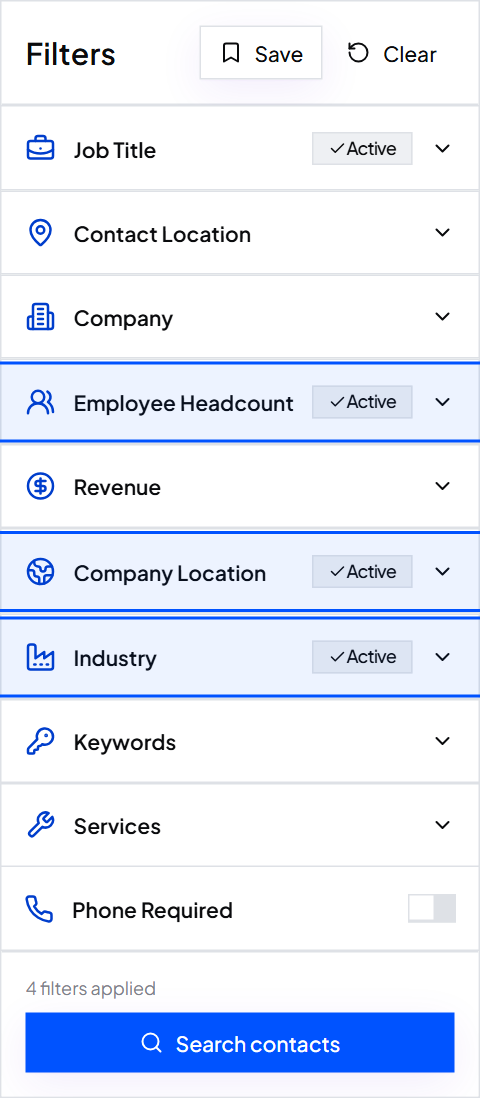
Tip: Exclude your current customers and obvious mismatches in the spreadsheet after export. ContactYard can't exclude named companies in the search itself.
Step 5: Save the search
Use Save so you can rerun it next month and find new matching people. See how in the segmenting guide.
Common mistakes
- Including customers that were easy, not good. A big logo that churned isn't a model.
- Using too many traits. Pick three or four. The rest can shape your message.
- Skipping the buyer. The right company with the wrong person gets no reply.
Keep reading
What is an ideal customer profile? (With examples)
What an ICP is, what goes in it, and five examples you can adapt for your own business.
How to find companies that have the problem you solve right now
Target a situation your buyer is in, not just a company profile. Learn which situations ContactYard filters can stand in for.
How to split one big list into segments that each get their own email
One email to a whole list sounds like it was written for nobody. Group people by shared situation and write once per group.