
How to get trucking contracts
To get trucking contracts, build a load history on boards and with brokers, bid on government freight if you can wait, and go straight to shippers on the lanes you already run. Direct is the best route: you call the logistics or shipping manager at a nearby manufacturer, win one trial load, then ask for the lane.
A trucking contract is an agreement between a carrier and a shipper or broker. It sets lanes, rates, fuel surcharge and payment terms. Many fix the rate without promising a volume, so repeat loads still depend on your service.
Tip: This page is for carriers looking for freight. Selling products to fleets? You want the trucking company email list instead.
The four routes to contract freight
| Route | How you get in | Good for | The catch |
|---|---|---|---|
| Load boards (DAT, Truckstop) | Pay a monthly fee and bid on posted loads | Filling trucks this week, learning which lanes pay | Spot prices, and every carrier sees the same load |
| Freight brokers | Sign a broker's carrier packet, then ask for repeat lanes | Steady work without finding customers | The broker sets your rate and owns the customer |
| Government freight | Register on SAM.gov, watch state and city bid sites, or bid Postal Service highway contract routes | Long terms and reliable payers | Slow paperwork, and low bids usually win |
| Direct shippers | List the people who book freight, then call and email them | Your own rates, repeat lanes, no middleman | You have to find them, and that's fixed below |
Use boards and brokers to keep trucks moving now. Each direct contract then replaces a spot load with freight you priced.
Who ships what you can haul
| Shipper | Freight | Truck | Industry filter |
|---|---|---|---|
| Food producers | Packaged, chilled and frozen food | Reefer, dry van | Agriculture and Food > Food and Beverage Manufacturing, Food Production |
| Food distributors | Mixed pallets to stores and kitchens | Reefer, dry van | Retail and Wholesale > Wholesale Food and Beverage |
| Metal and machinery makers | Steel, parts, equipment | Flatbed, step deck | Manufacturing > Fabricated Metal Products, Machinery Manufacturing |
| Building material suppliers | Lumber, roofing, pipe | Flatbed | Retail and Wholesale > Wholesale Building Materials |
| Packaging and plastics makers | Pallets of finished goods | Dry van | Chemicals and Materials > Packaging and Containers Manufacturing, Plastics Manufacturing |
Who books the freight
| Employee Headcount | Who decides | Job titles to search |
|---|---|---|
| 11 to 20 | The owner, on small volumes | Owner, President, General Manager |
| 21 to 100 | Owner or the operations lead | President, Operations Manager, Plant Manager, Shipping Manager |
| 101 to 250, 251 to 500 | A logistics lead, your best band | Logistics Manager, Transportation Manager, Traffic Manager, Shipping Manager, Distribution Manager, Supply Chain Manager |
| 501 to 1000 and up | A corporate team running yearly freight bids | Director of Logistics, Director of Transportation, VP of Supply Chain |
More on this logic in how to find decision makers.
Where direct outreach goes wrong
- Searching your own industry. Transportation and Logistics returns other carriers and brokers: your competitors. Filter by what the shipper makes.
- “We haul anything, anywhere.” A shipping manager thinks in lanes. Name the route and the truck.
- Starting with giants. A 5,000-person shipper buys through yearly bids. A 150-person plant can try a new carrier next Tuesday.
- Asking for a contract first. Nobody signs one with a stranger. Ask for one backup load.
How to win direct freight
Step 1: Pick one lane and one truck
Start where you already run, ideally a lane where you often come back empty. A backhaul shipper is the easiest first win.
Step 2: Build your shipper list in ContactYard
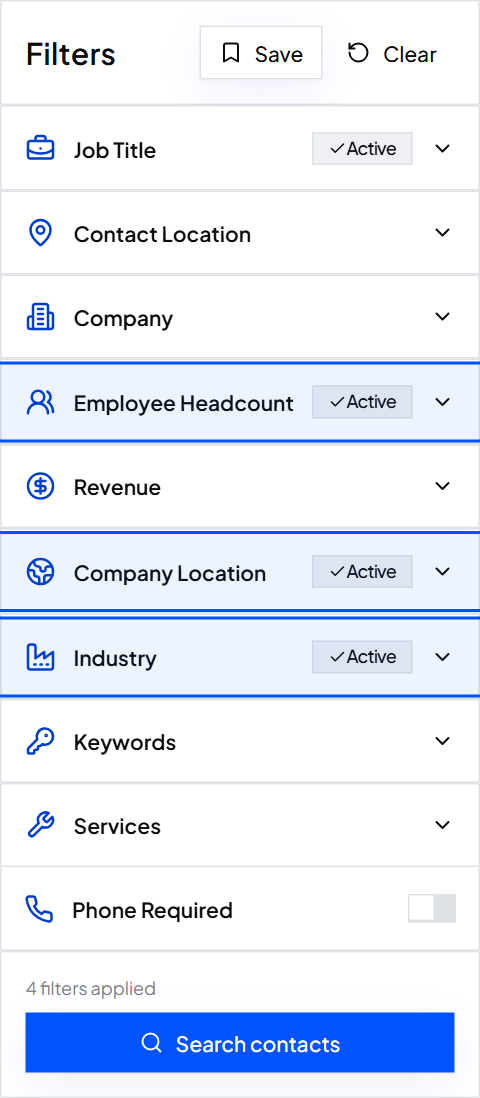
- Industry: your row from the shipper table.
- Company Location: the states and cities on your lane.
- Employee Headcount: 21 to 100, 101 to 250 and 251 to 500.
- Keywords: a freight clue such as “frozen”, “steel” or “lumber”.
- Email required and Phone required on, because you will call.
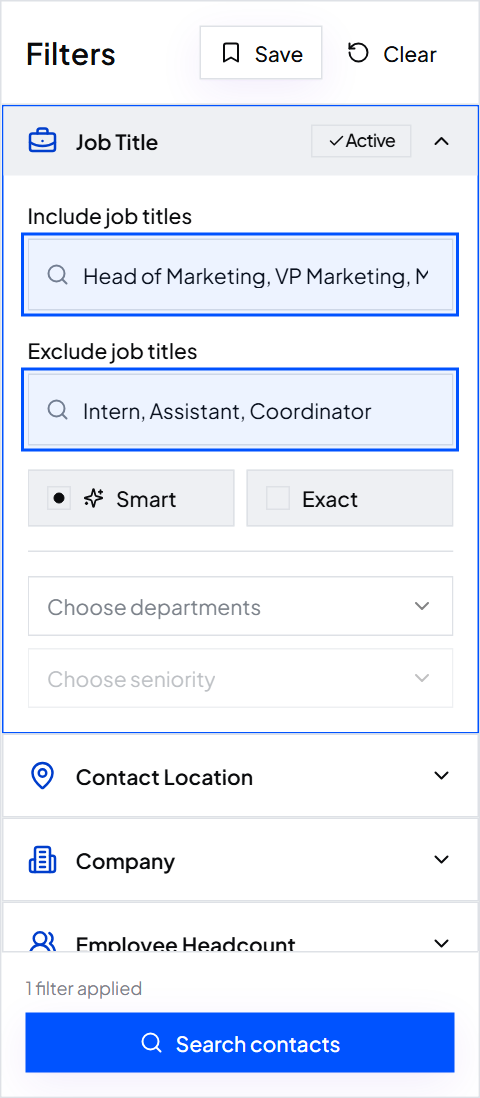
In Job Title, use Smart mode with the titles above, then add this to Exclude:
Intern, Assistant, Analyst, Consultant, Sales, Driver
Export the CSV and click Save so you can rerun the search next month. One credit covers the verified work email, the mobile when available and the verification. Before you call, open the Website column and check where each company's plants are.
Step 3: Have your carrier packet ready
Keep one PDF with your MC and DOT numbers, certificate of insurance, W-9, equipment list, and two references from brokers you have hauled for.
Step 4: Email, then call
Subject: Backup truck for {origin} to {destination} Hi {first_name}, I run {number} {truck type} trucks and go through {origin} to {destination} every week, so I usually have room on that lane. If {company} ever gets stuck on a late or rejected load going that way, I'd like to be your backup. No commitment, one load at a time. Who should get my carrier packet? {Your name} {Your company}, {phone}
Call two days later. At a small plant, whoever books freight often picks up the phone. Then follow up twice. Wording help is in how to write a cold email.
Step 5: Turn one load into a lane
- Haul the trial load, on time, and send the proof of delivery the same day.
- Offer a fixed rate for that lane for the next 90 days.
- Put lane, rate, fuel surcharge, payment terms and claims in writing.
- Ask what else ships the same way.
Tip: Shippers often pay on 30 days or longer. Price that into your rate, or line up factoring first.
Worked example: Fernway Hauling
Fernway Hauling, fictional six-truck flatbed carrier in Birmingham, Alabama (illustrative numbers)
- Lane
- Birmingham to Atlanta, usually empty on the way back
- Search
- Fabricated Metal Products and Wholesale Building Materials, Alabama and Georgia, 21 to 100 and 101 to 250 employees
- List
- 500 contacts with Email required and Phone required
- Data cost
- ContactYard Growth: $49 a month for 10,000 contacts
- Same 500 elsewhere
- 2,000 to 6,000 credits at 4 to 12 credits per contact
- Goal
- Two contract lanes in three months
One weekly contract load pays for the data many times over. ContactYard Scale costs about $3.30 per 1,000 contacts, against published prices of $18 at Apollo and $75 at Lusha.
The same habit wins commercial cleaning contracts too.
FAQ
- How do I get trucking contracts?
- Build history on load boards and with brokers, then call and email logistics managers at shippers on your lanes. Win one trial load, then ask for the lane.
- How do I get a trucking contract as an owner-operator?
- Run under your own authority and pitch one lane to shippers in the 21 to 100 and 101 to 250 headcount bands. Offer to be their backup truck.
- How do I find trucking contracts?
- Government contracts are posted on SAM.gov and state bid sites. Shipper contracts are rarely posted, so find the buyers yourself in ContactYard by industry, headcount and location.
- What is a trucking contract?
- An agreement between a carrier and a shipper or broker covering lanes, rates, fuel surcharge, payment terms and claims. Many fix the rate but not the number of loads.
Start free, filter to the shippers on your best lane, and see how many freight buyers you can call this week.
Keep reading
How to write a cold email
The parts of a cold email that gets replies, step by step, with a before and after rewrite.
How to find decision makers in a company
Who decides at each company size and department, and how to find them at 1,000 companies at once.
How to get clients for your cleaning business
Win homes through local search and referrals, and commercial contracts by calling and emailing managers.