
How to follow up on an email with no reply: timing and templates
When to send each follow-up, how many is too many, same thread or new, and 8 B2B follow-up templates you can copy, from the first nudge to the breakup email.
To follow up on an email with no reply, wait 3 business days, reply in the same thread with a short message that adds one new thing, and send no more than 3 follow-ups to a cold contact before you stop. Each follow-up should give the reader a fresh reason to answer: a useful idea, a proof point, a different angle or an easy question.
Silence rarely means no. People are busy, your email arrived at a bad moment, or it went to the wrong person. This guide covers when to send a follow-up in each B2B situation, how many follow-up emails is too many, same thread vs new thread, what to say each time, subject lines, and eight templates you can paste today.
When to send a follow-up email
The right wait depends on how warm the conversation is. The warmer it is, the sooner you follow up. Use this table as your default and adjust when the person gave you a date.
| Situation | First follow-up | Next follow-ups | When to stop |
|---|---|---|---|
| Cold email, no reply | 3 business days later | 4 to 5 days, then about a week | After 3 follow-ups, roughly 3 weeks in total |
| After a meeting or call | Same day: a recap with the agreed next step | 3 business days if the next step stalls | After 2 nudges, then call instead |
| After sending a proposal | 2 to 3 business days, to answer questions | Weekly, tied to their decision date | When the decision date has passed and a breakup email gets no answer |
| After sending a quote | 2 business days | A reminder a few days before the quote expires | When the quote expires: send one last note and close it |
| After an introduction | Within 24 hours of the intro, reply to all | 3 business days, then a week | After 2 follow-ups. Thank the person who introduced you either way |
| They asked you to get back later | On the day they named | 1 week, then 2 weeks | After 2 follow-ups past their date |
Tip: If someone tells you a date, such as “after our board meeting on the 14th”, that date beats any rule. Put it in your calendar and follow up the next working day.
How long to wait between follow-ups
Space follow-ups out more each time. A tight gap at the start catches people who simply missed the email. A longer gap later stops you from feeling pushy. For cold outreach, a common rhythm is day 0, day 3, day 8 and day 15, with a breakup email around day 21 if you want a fourth touch.
Send during the reader's working morning in their own time zone, Monday to Thursday. Friday afternoons and weekends are when emails get buried under everything that arrives on Monday.
How many follow-up emails is too many?
For cold email, 3 follow-ups after the first email is the safe ceiling: four emails in total, spread over about three weeks. Past that, extra emails earn few replies and more spam reports, and spam reports hurt every future email you send from that domain.
For people you have already met, you can keep following up while there is a live deal, but stretch the gaps to a week or more and make every email useful. Two unanswered nudges in a row is your sign to switch channel, not to send a third.
- Stop at once when someone replies, says no, or asks to be removed. Add them to your suppression list. Is cold email legal covers opt-out rules by country.
- Stop when the address bounces. A bounce is not a no, it is a dead address. Fix the data, not the copy.
- Stop when you have nothing new to say. A follow-up that only repeats the first email is noise.
- Pause, don't stop, when they said “not now”. Note the reason and come back next quarter. When to email the same list again explains how.
Same thread or new thread?
Reply in the same thread for your first two or three follow-ups. The reader sees your original email underneath, so you don't need to repeat yourself, and the follow-up stays short. Start a new thread when the topic, the timing or the person changes.
| Use the same thread when | Start a new thread when |
|---|---|
| It's a short nudge on the same offer | You're pitching a different angle or a different offer |
| The original email is still relevant context | More than a month has passed |
| You follow up within the first two or three weeks | You're writing to a different person at the company |
| You're following up after a call or proposal | The thread has grown long and messy |
What to say in each follow-up
Every follow-up needs one new reason to reply. “Just bumping this” gives the reader nothing; a useful idea, a customer result or a better question gives them something. Plan the new thing for each step before you send the first email.
| Step | When | What's new in it |
|---|---|---|
| First email | Day 0 | The problem, the result you deliver and one easy question |
| Follow-up 1 | Day 3 | A shorter restatement and a yes or no question |
| Follow-up 2 | Day 8 | Something useful: a tip, a benchmark from your own work, a short teardown |
| Follow-up 3 | Day 15 | A different angle on the problem, or “am I asking the right person?” |
| Breakup | Day 21 | A polite close that makes it easy to say “not now” or “later” |
Lead with value whenever you can. Send something useful before asking for a call has three kinds of small gifts you can build from a company's website in a few minutes.
Phrases to cut from follow-ups
- “Just bumping this to the top of your inbox.” It says you have nothing new.
- “Did you see my last email?” They did, or they didn't. Either way it puts them on the spot.
- “Per my last email.” Reads as irritated, even when you don't mean it.
- “I know you're busy, but...” Starts with a guilt trip.
- “Circling back” or “touching base” with no reason. Say the reason instead.
Follow-up subject lines
In the same thread, keep the original subject. Your email app adds “Re:” and the reader sees the full conversation. For a new thread, write a short, plain subject that names their company or problem. Three to six plain words, no clickbait.
- Idea for {company}'s {process}
- {first_name}, a different angle
- Right person for {topic}?
- Recap and next steps
- Your quote from {your company}
- Closing the loop
Tip: Never fake a reply with “Re:” on a brand-new email. It's deceptive, it breaks the honest-subject rule under US CAN-SPAM, and readers notice.
8 follow-up email templates you can copy
Replace everything in curly brackets. Keep each one under 80 words. Need first emails too? See cold email templates and how to write a cold email.
1. First follow-up to a cold email
Hi {first_name}, Short version of my note below: we help {job_title}s at companies like {company} cut {problem} by {result}. Is that on your list this quarter, yes or no? {Your name}
2. Value add
Hi {first_name}, While looking at {company}, I noticed {specific observation}. Teams that fix this usually start by {one practical step}. I wrote up a short checklist for it. Want me to send it over? No call needed. {Your name}
3. Different angle
Hi {first_name}, I may have led with the wrong problem. Most {job_title}s we work with care less about {first angle} and more about {second angle}. {Similar customer} used us to {specific result} in {timeframe}. Is {second angle} closer to what's on your plate? {Your name}
4. Right person?
Hi {first_name}, I might have the wrong person. Who at {company} looks after {area}? If it's you, happy to send a two-line summary. If not, a name is all I need and I'll leave you be. Thanks, {Your name}
Better still, find the right person yourself before you ask. How to find decision makers in a company shows how to search by title at one company.
5. After a call or meeting
Hi {first_name}, Thanks for your time today. Quick recap: - You're dealing with {problem}, costing roughly {impact}. - We agreed {next step} by {date}. - I'll send {what you promised} by {date}. Anything I missed? If not, I'll see you on {date}. {Your name}
Hi {first_name}, Following up on {next step} from our call. To make it easy, here's {the document or answer they needed}. Does {specific day} still work, or should we move it? {Your name}
6. After a proposal or quote
Hi {first_name}, Checking in on the {proposal or quote} I sent on {date}. Two questions usually come up at this point: {common question 1} and {common question 2}. Short answers are below in case they help. {answer 1} {answer 2} The pricing holds until {expiry date}. Would a 10-minute call with {other stakeholder} help before then? {Your name}
7. After an introduction
Hi {first_name}, {Introducer} thought we should talk because {reason from the intro}. I know these emails can slip, so here's the short version: {one line on what you do and the result}. Would {two specific days} work for 15 minutes? Happy to work around you. {Your name}
8. The breakup email
Hi {first_name}, I haven't heard back, so I'll assume {problem} isn't a priority right now. No problem at all. If that changes, just reply to this email and I'll pick it up from here. Either way, I won't keep writing. All the best, {Your name}
Tip: Breakup emails tend to draw replies because they make “not now” an easy answer. Log those replies and contact them again when they said to.
No reply? Check the address before you rewrite the email
Many “no replies” are not people ignoring you. They are emails that never reached a person. Contacts leave their jobs, mailboxes close, and a guessed address on a domain that accepts every email looks delivered while nobody reads it. You could follow up perfectly for three weeks and still be writing to an empty inbox.
- The person left. People change jobs all the time, so a list that was right six months ago is already wrong in places. How fast contact data goes stale shows how to measure it.
- The address was guessed. Pattern guesses like first.last@ bounce or vanish more often than you think.
- The domain accepts everything. Catch-all mail servers say yes to any address, so a wrong one doesn't bounce. It just never gets read.
- It bounced and nobody looked. A high bounce rate also pushes your good emails toward spam. Why your bounce rate is high explains the fixes.
The fix is a verified list from ContactYard. Every work email is verified before you get it, and the data is refreshed every 30 days, so you write to people in their current job. One credit gives you the verified work email and the mobile when available, with no separate verifier to pay for. On the Scale plan that's about $3.30 per 1,000 contacts.
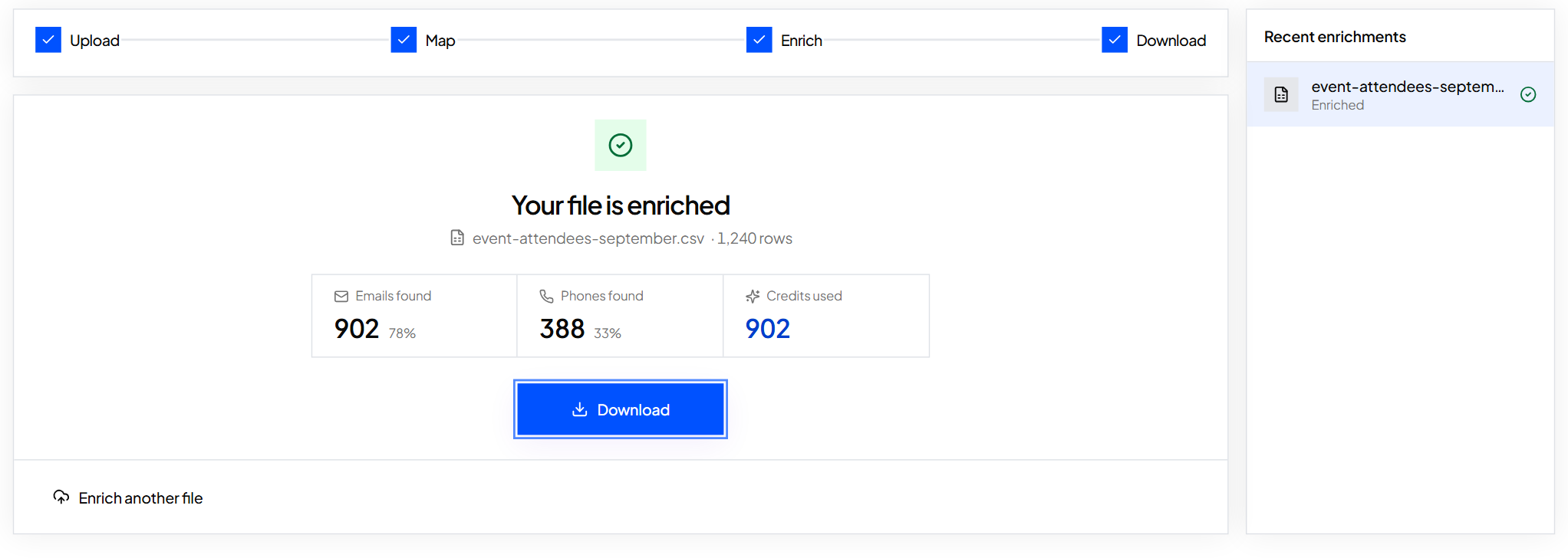
Already have a list that's gone quiet? Upload it to Enrich Contacts and get it back with current verified work emails and mobiles. Then clean the list before you send the next round.
Switch channels: call the mobile number
After two unanswered follow-ups, the best next touch is often a call, not a third email. A short call in someone's working morning cuts through an inbox in a way no subject line can. ContactYard includes the mobile number, when available, in the same credit as the email, so every row in your export is ready for a call as well as an email.
Hi {first_name}, it's {your name} from {your company}. I sent you a couple of emails about {problem} and thought a 30-second call might be easier. Is now a bad time? [If they let you go on] We help {job_title}s at companies like {company} {result}. Is that something you're looking at, or should I stop chasing?
Hi {first_name}, {your name} from {your company}. I emailed you about {problem} at {company}. I'll send one short note today with the details, so no need to call back. Thanks.
LinkedIn is the third channel. A short connection note that mentions your email gives the reader another place to answer. See how to write a cold LinkedIn message, and how to get phone numbers for cold calling for call list columns and calling rules.
Worked example: Brightpath's follow-up sequence (fictional)
- Audience
- Heads of finance at logistics firms, 50 to 200 employees
- List
- 400 contacts from ContactYard, every work email verified, mobiles included in the same credit
- Day 0
- First email: invoice errors, one result, one question
- Day 3
- Follow-up 1, same thread: one-line restatement and a yes or no question
- Day 6
- Call the mobile of everyone who hasn't replied, and leave the voicemail above
- Day 8
- Follow-up 2, same thread: a three-point invoice checklist
- Day 15
- Follow-up 3, new thread: the cash-flow angle instead of the error angle
- Day 21
- Breakup email, same thread as follow-up 3
- After
- “Not now” replies tagged with a date to come back. Everyone else rests for a quarter
Common follow-up mistakes
- Following up too soon. A follow-up the next morning on a cold email reads as pressure.
- Following up forever. Three follow-ups for cold email, then stop or switch channel.
- Sending the same email again. Each follow-up needs one new thing.
- Writing longer each time. Follow-ups should get shorter, not longer.
- Asking for a big commitment. A yes or no question beats “Can we book 45 minutes?”
- Ignoring bounces. A bounce means the data is wrong. Replace it with a verified contact.
- Following up after an opt-out. It's the fastest route to a spam report, and it breaks the law in most countries.
What to do next
Good follow-ups only work when they reach a real person. Start free on ContactYard, export a verified list with mobiles included, and run the sequence above this week. New to cold outreach? Start with what a cold email is.
FAQ
- When should you send a follow-up email?
- For a cold email, send the first follow-up 3 business days after the original. After a meeting, send a recap the same day. After a proposal or quote, follow up within 2 to 3 business days. If the person named a date, follow up on that date.
- How long should I wait to follow up on an email?
- Wait 3 business days for the first follow-up, then make each gap longer: about 5 days, then a week. Around day 21, send a short breakup email and stop.
- How many follow-up emails is too many?
- For a cold contact, more than 3 follow-ups after the first email is too many. Four emails over about three weeks is the safe ceiling. Stop at once if they reply, say no or ask to be removed.
- How many follow-up emails should I send?
- Two or three. Make each one add something new, such as a useful tip, a different angle or a “right person?” question, then finish with a polite breakup email or switch to a phone call.
- Should I follow up in the same email thread?
- Yes, for the first two or three follow-ups on the same offer. Start a new thread when you change the angle, write to a different person, or more than a month has passed.
- Why am I getting no reply to my follow-ups?
- Often the address is wrong or dead: the person left, the address was guessed, or the domain accepts every email without delivering it to anyone. Use verified contacts from ContactYard, refreshed every 30 days, and call the mobile number included with each contact.
Keep reading
What is a cold email? How to send one that gets replies
A cold email is a first message to someone you have never spoken to. Learn how it differs from spam, how to set up sending, and copy a template that works.
When to email the same list again, and what to change
Most people don't remember your first email. Here is when to contact the same market again and how to keep it fresh.
How to get phone numbers for cold calling
Where cold callers get direct dials and mobile numbers, how to build a call list for B2B and real estate, the columns to track, and the calling rules to follow.