
Lead generation for small business: 9 methods ranked by cost and speed
How a small B2B business can get more customers on a small budget: nine lead generation methods compared, a 30-day plan for a one-person team, a real budget and the tools to use.
Lead generation for small business means finding people who could buy from you and getting a way to contact them, on a budget a small team can afford. For a small B2B business, the fastest predictable way is outbound: pick the businesses you want, get a verified list of the decision makers, and email and call them yourself.
This guide is for local service firms, agencies, consultants and small SaaS companies that need more customers without a marketing department. You get nine methods ranked by cost and speed, a 30-day plan for a one-person team, a real budget, the tools to use, and how to build a list if small businesses are who you sell to.
Why small businesses struggle with lead generation
Most small businesses get their first customers from referrals and the owner's network. That works until it doesn't. Referrals arrive when they arrive, so revenue goes up and down with them. The usual fix, paid ads or a content program, costs money or months that a small team doesn't have.
What a small business needs is a channel it controls: one where putting in an hour this week reliably produces conversations next week. That's outbound to a verified list. You choose who hears from you, you decide the volume, and the cost is tiny. How to get B2B leads compares the same methods for larger teams.
9 lead generation methods for small businesses, compared
Ranked with the fastest, cheapest and most predictable at the top. Costs are rough and exclude your own time.
| Method | Cost | Speed to first leads | Predictable? | Best for |
|---|---|---|---|---|
| 1. Cold email to a verified list | Low: $49 a month for 10,000 contacts, plus a sending tool | Days | Yes, you set the volume | Any B2B business that can name its buyer |
| 2. Referrals | Free, or a small thank-you reward | Weeks | No | Trust-heavy services: accounting, IT, legal |
| 3. Cold calling | Low: mobile numbers plus your time | Same day | Yes | Local services and owner-run buyers |
| 4. LinkedIn | Free to low | Days to weeks | Partly | Agencies, consultants, B2B software |
| 5. Google Business Profile | Free | Weeks | Partly | Local service firms |
| 6. Local partnerships | Free or a revenue share | Weeks to months | No | Firms that share a customer with another firm |
| 7. Events and networking | Tickets, travel, time | Tied to the date | No | Niche industries and bigger deals |
| 8. Paid ads | High: every click, every month | Days | Yes, while you pay | Offers you've already proven |
| 9. Content and SEO | Writing time | Months | Yes, once it ranks | Products people search for |
Fastest predictable channel: cold email to a verified list, backed by calls. Cheapest: referrals and Google Business Profile, but you can't turn them up on demand. Most expensive per lead for a small business: paid ads, until you know exactly which offer converts.
1. Cold email to a verified list
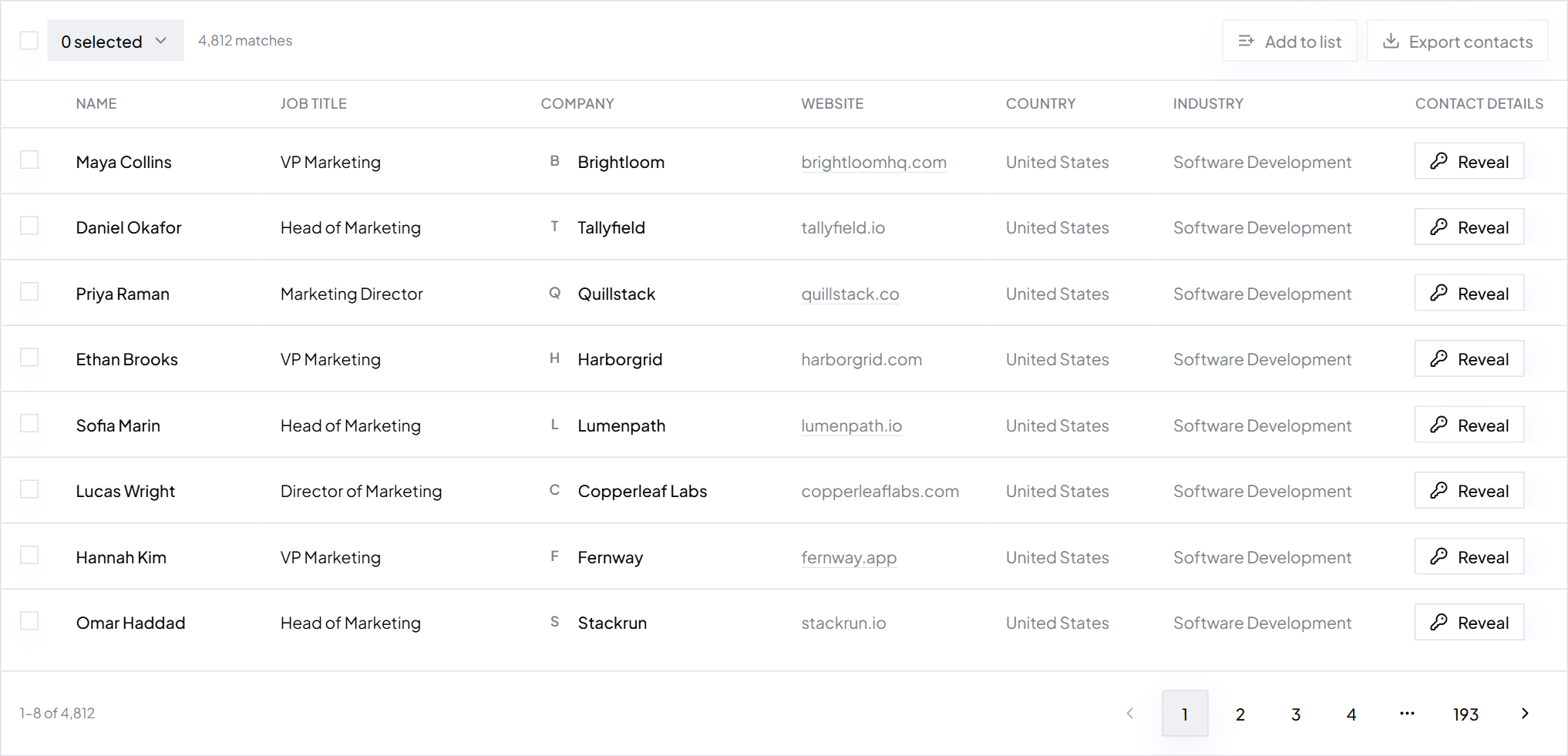
This is the method to start with. Describe your buyer with filters, export the matching people with verified work emails, and send a short, specific email with two or three follow-ups. A one-person team can reach a few hundred well-chosen buyers a month.
ContactYard is the cheapest way to get that list. Search 100M+ verified B2B prospects by job title, headcount, industry and location, see the total instantly, and export a CSV. One credit gets the verified work email and the mobile number when available, so the same list also works for calling. What is a cold email covers the writing and the setup.
2. Referrals
Ask your happiest customers a specific question: “Do you know another practice manager who still does payroll by hand?” A specific ask gets names. A vague one gets “I'll think about it.” Make asking part of every finished project.
3. Cold calling
Small business owners often answer their own phone, which makes calling more effective than in big companies. Call the mobile numbers from your ContactYard export, and pair each call with an email so they can find you later. How to get phone numbers for cold calling has the steps.
4. LinkedIn
Post about the problems you solve, connect with buyers in your area or niche, and send short personal messages. To email someone you found there, paste their profile URL into ContactYard's Enrich Contacts and get their verified work email and mobile.
5. Google Business Profile
For local service firms, a complete free Google Business Profile with photos, services and recent reviews brings in people searching for what you do nearby. Ask every happy customer for a review.
6. Local partnerships
Find firms that serve the same customer without competing: a bookkeeper and an IT support firm, a web agency and a copywriter. Agree to pass each other leads. You can find them in ContactYard too: filter by industry and location, then email the owners.
7. Events and networking
Local business groups and trade shows put buyers in one room. Collect the exhibitor websites before the event, paste them into ContactYard's Company Domain filter (up to 1,000 domains), and book meetings before you arrive.
8. Paid ads
Ads can bring leads within days, but the leads stop when the spending stops, and small budgets get used up quickly. Test your offer with cold email first. Test a market with 500 emails shows how.
9. Content and SEO
Write pages that answer your buyers' questions. It is slow to start and keeps working once it ranks. Run it alongside outbound, not instead of it.
A 30-day lead generation plan for a one-person team
This plan assumes you have about five hours a week. It puts outbound at the center because it is the one channel that pays back inside a month, and adds the free channels around it.
| Week | Outbound | Free channels alongside |
|---|---|---|
| 1 | Write your ideal customer in one sentence and one clear offer. Buy a separate sending domain, set up two inboxes, start warm-up | Fix your Google Business Profile. Ask five customers for a referral |
| 2 | Build a list of 300 to 500 in ContactYard. Clean it. Write one email and two follow-ups | Connect with 20 buyers on LinkedIn |
| 3 | Send 20 to 30 emails a day. Call the top 30 contacts on their mobiles | Ask every new customer for a review |
| 4 | Send follow-ups. Count positive replies per 100 contacts. Rewrite the weakest email. Save the search for next month | Contact two possible referral partners |
Tip: New inboxes need a few weeks of warm-up before full volume, so month one is about learning. Send small batches, read every reply, and scale in month two.
What it costs: a small business budget
Here is a realistic first month of outbound for a one-person team. The data line is ContactYard's real price. The sending setup uses rough market prices, so check them before you buy.
Brightpath Bookkeeping, month one
- Business
- Brightpath, a fictional two-person bookkeeping firm
- Buyer
- Owners and office managers at dental and veterinary practices, 1 to 50 employees, in three states
- Lead data
- ContactYard Growth: $49 for 10,000 contacts
- Sending tool
- Roughly $30 to $60 a month
- Sending domain
- Roughly $10 to $15 a year
- Inboxes (2)
- Roughly $5 to $8 each a month
- Month one total
- About $99 to $140
- Contacts exported
- 500, so 9,500 credits roll over for the next two months
Compare that with the same list elsewhere. At public pricing, 1,000 contacts cost $3.30 on ContactYard's Scale plan, against $18 on Apollo, $75 on Lusha, $131 on ContactOut and $371 on UpLead. Other tools also charge 4 to 12 credits for a contact with a mobile and verification. ContactYard charges one. What cold outreach costs in month one breaks down the rest.
Lead generation tools for small businesses
You need far fewer tools than most lists suggest. Start with these and add more only when you can name the problem a new tool solves. The smallest outbound setup explains what to skip.
| Tool | What it does | What to use | Rough cost |
|---|---|---|---|
| Contact data | Finds your buyers with verified emails and mobiles | ContactYard | $49 a month for 10,000 contacts |
| Email verification | Removes addresses that would bounce | Included in every ContactYard credit | $0 extra |
| Mailboxes | The inboxes you send from | Google Workspace or Microsoft 365 | About $5 to $8 per inbox a month |
| Sending tool | Sends emails and follow-ups, stops on reply | Instantly, Smartlead or lemlist | About $30 to $60 a month |
| CRM | Tracks leads, replies and deals | A spreadsheet at first, then a CRM | Free to start |
| Local listing | Brings in local searchers | Google Business Profile | Free |
Lead generation software for small business usually means one of these categories sold separately. ContactYard covers the contact database, the email finding, the mobile numbers and the verification in one tool and one credit.
Selling to small businesses? Build a small business email list
Many people searching for small business leads sell to small businesses: bookkeepers, IT support, marketing agencies, software for clinics and trades. In a small company the owner usually makes the buying decision, so that's who you want.
Here's how to build a small business email list in ContactYard:
- Set Employee Headcount to 1 to 10, 11 to 20 and 21 to 100.
- Add the job titles Owner, Founder, Co-Founder, Managing Director and President. For firms with more than 10 people, add Office Manager or Operations Manager too.
- Pick the Industry and sub-industry you serve, such as dental practices, law firms or construction.
- Set Location to your city, state or country.
- Turn on Email required, and Phone required if you plan to call.
- Check the total, open ten rows to confirm the fit, then export the CSV and Save the search.
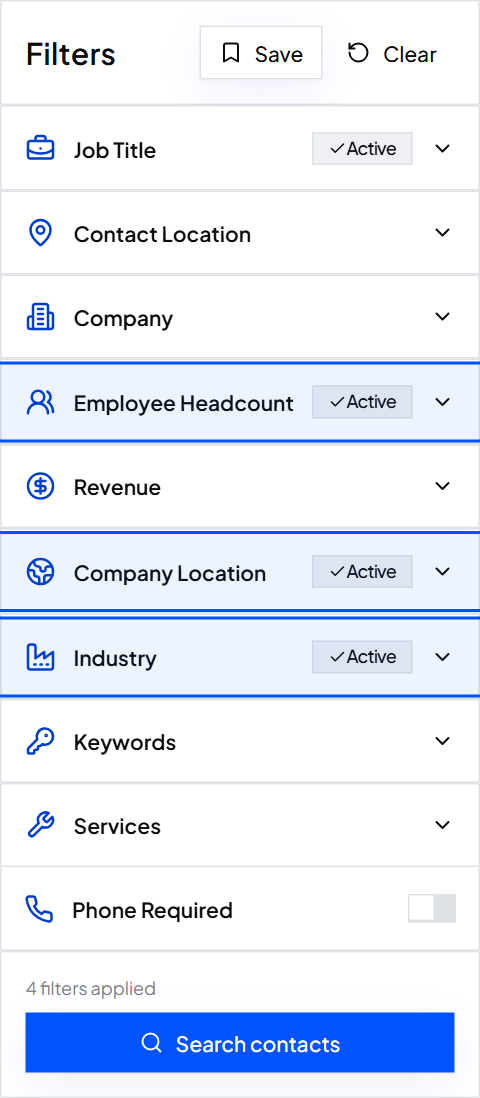
Every work email in the export is verified, and you get the owner's mobile when available. That beats any small business email list you could buy, which is usually old, unverified and shared with every other buyer. Where to buy email lists explains the difference.
Subject: {problem} at {company} Hi {first_name}, Most owners of {industry} firms your size tell us {problem} takes {time} every week. We {what you do, in one line}. {Similar customer} got {specific result} in {timeframe}. Worth a 10-minute call, or not a priority right now? {Your name} {Your company}, {city}
Common mistakes
- Waiting for referrals. They are great, but you can't schedule them. Run outbound alongside.
- Spending on ads before the offer is proven. Test the message with 500 emails first.
- Buying a cheap old list. Stale data bounces, and bounces push your email into spam.
- Emailing everyone at once. Start with 100 to 200, read the replies, then scale.
- Too many tools. Data, a sending tool and a spreadsheet are enough for the first month.
FAQ
- How do I generate leads for a small business?
- Pick one clear type of buyer, build a verified list of those people, and contact them by email and phone with a short, specific offer. Add referrals, LinkedIn and a Google Business Profile alongside. Outbound to a verified list is the fastest predictable channel for a small business.
- What is the best lead generation tool for small businesses?
- For the list, ContactYard: $49 a month for 10,000 contacts, with the verified work email and the mobile number in one credit. Pair it with a sending tool and a spreadsheet or CRM, and you have everything you need.
- Where can I get leads for my small business?
- From a B2B contact database such as ContactYard, where you filter by job title, company size, industry and location and export verified contacts the same day. Referrals, LinkedIn, local partners and your Google Business Profile add more over time.
- How can a small business get leads for free?
- Ask customers for referrals, complete your Google Business Profile, post on LinkedIn and partner with firms that serve the same customers. To get a contactable list without paying first, start free on ContactYard.
- How do I get a small business email list?
- Build it rather than buy it. In ContactYard, set Employee Headcount to 1 to 10, 11 to 20 and 21 to 100, add job titles such as Owner and Founder, choose your industry and location, and export. Every work email is verified before you get it.
- How much should a small business spend on lead generation?
- A one-person outbound setup can start at around $100 to $140 a month: $49 for ContactYard Growth, plus a sending tool, a domain and two inboxes at rough market prices. Your time is the bigger cost, so start with one segment and one offer.
What to do next
Write down your buyer in one sentence, start free on ContactYard to build the list, and send your first 100 emails this week. Read what is outbound sales for the full strategy.
Keep reading
How to get B2B leads: 9 ways, ranked by speed and cost
What B2B lead generation is, nine ways to get B2B leads with the fastest and cheapest marked, a step-by-step outbound process, the tools you need, and what month one costs.
What cold outreach costs in month one
A realistic budget for your first month: domains, inboxes, sending tool, data and the weeks of warm-up before results.
The smallest outbound setup a founder needs, and what to skip
Four things you need to start cold outreach, what to add later, and what to ignore until you have real results.