
How to get bookkeeping clients: pick a niche, build a list, make one offer
The fastest route to a full book: one niche, a verified list of business owners, one simple fixed-price offer and a few CPA referral partners. With exact filters, two emails and a 30-day plan.
The fastest way to get bookkeeping clients is to pick one niche, build a list of business owners in that niche with verified emails and phone numbers, and send them one simple, fixed-price offer. CPA referrals, the QuickBooks and Xero advisor directories and local networking add to that, but they make you wait. A niche plus a verified owner list from ContactYard puts you in front of hundreds of right-fit owners this week.
This guide is for freelance bookkeepers and small bookkeeping firms. It covers how to choose a niche, who to contact, every channel compared, the exact filters to build your list, two cold emails to copy, how to work with CPAs, and a 30-day plan.
Why bookkeepers struggle to find clients
Most bookkeepers market themselves as “bookkeeping for small businesses”. That describes millions of businesses and none of them in particular. It causes three problems.
- Nobody remembers a generalist. A restaurant owner remembers “the bookkeeper who does restaurants”. They forget “a bookkeeper”.
- Waiting for referrals. Referred clients are great, but you can't decide when the next one arrives.
- Competing on hourly rate. Without a niche, price is the only difference a buyer can see.
Fix the first and the other two get easier. Then a list fixes the waiting.
Step 1: pick a niche
A niche is a type of business whose books look alike. You learn the software, the problems and the vocabulary once, then sell the same expertise again and again. Good niches have lots of small owner-run businesses, messy books and owners who hate doing them.
| Niche | What makes their books hard | ContactYard filters |
|---|---|---|
| Construction and trades | Job costing, progress billing, retainage, subcontractor 1099s, equipment loans | Industry: Construction > Specialty Trade Contractors. Services: Plumbing, Electrical, HVAC, Roofing |
| Restaurants | Daily sales reconciliation, tips, delivery app payouts, food cost, sales tax | Industry: Hospitality and Travel > Restaurants. Services: Restaurants |
| Dental and medical practices | Insurance receivables, provider pay, equipment financing | Industry: Healthcare > Dentists, Medical Practices. Services: Dentistry, Medical Services |
| Ecommerce brands | Marketplace and payment payouts net of fees, inventory, sales tax in several states | Industry: Retail and Wholesale > Online and Mail Order Retail |
| Real estate agencies | Commission splits, agent payouts, trust or escrow accounts | Industry: Real Estate > Real Estate Agents and Brokers. Services: Real Estate Services |
| Accounting firms, as partners | They want bookkeeping off their desk before tax season | Industry: Business Services > Accounting |
Tip: Pick the niche where you already have two clients, or where you used to work. “I did the books for a 12-van HVAC company for four years” beats any certificate in a cold email.
Not sure the niche is big enough? Check before you commit. ContactYard shows the total count as you filter, and searching is free, so you'll know in a minute whether your area has 300 or 3,000 owners in that niche. Is your market big enough for cold outreach explains how to read the number.
Step 2: know who to contact
In businesses with 1 to 50 employees, the owner decides. In practices and agencies, the office or practice manager often handles the books day to day and feels the pain first.
| Business type | Contact first | Also contact |
|---|---|---|
| Trades and construction, 1 to 20 staff | Owner, Co-Owner, President, Founder | Office Manager |
| Restaurants | Owner, Co-Owner | General Manager |
| Dental and medical practices | Owner, Managing Partner | Practice Manager, Office Manager |
| Ecommerce brands | Founder, Owner, CEO | Operations Manager |
| Real estate agencies | Broker Owner, Managing Broker, Owner | Office Manager |
| Accounting firms (partners) | Partner, Managing Partner, Owner | Practice Manager |
Use the Employee Headcount bands 1 to 10 and 11 to 20 for the classic owner-run business. Add 21 to 100 if you handle larger books or payroll. What sales leads are explains how to tell a real lead from a name on a list.
Ways to find bookkeeping clients, compared
| Channel | Time to first client | Cost | What to know |
|---|---|---|---|
| Cold email to a niche owner list | Weeks | Low: ContactYard Growth is $49 a month for 10,000 contacts | The only channel where you pick the niche, the town and the volume |
| CPA and accounting firm referrals | Weeks to months | Free, often two-way | The steadiest source once two or three firms trust you |
| Business bankers | Months | Free | They meet owners opening accounts and applying for loans |
| QuickBooks ProAdvisor and Xero advisor directories | Months | Certification time | Owners and accountants search them by location and industry |
| Google Business Profile | Months | Free | Catches “bookkeeper near me” searches. Reviews matter most |
| Weeks | Your time | Post about your niche's problems and connect with owners in it | |
| Local networking and trade associations | Months | Membership fees | Join the niche's own group, like a contractors' association, not only the chamber |
| Freelance marketplaces | Days | Platform fees | Quick first clients, but price-driven buyers |
Directories, Google and networking are worth setting up once and leaving to run. They are slow, and you don't control the flow. Cold email to a niche list is the channel you can turn on today, so it should carry your first 30 days.
Step 3: build your owner list in ContactYard
The example follows Fernway Books, a fictional two-person firm in Phoenix that has picked plumbing, electrical and HVAC contractors as its niche.
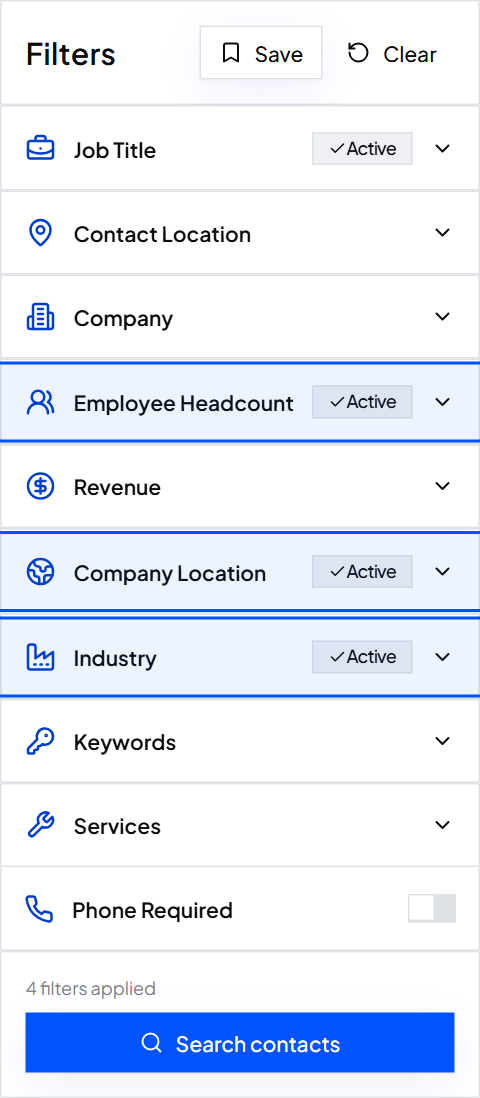
Step 1: Set the location
Fernway sets Company Location to Phoenix, Mesa, Chandler, Scottsdale, Tempe and Glendale. Bookkeeping is remote work, so you can go statewide later, but local owners trust a local bookkeeper faster and you can offer to meet.
Step 2: Choose the industry and services
Set Industry to Construction, sub-industry Specialty Trade Contractors. Then use Services to pick the trades you know: Plumbing Services, Electrical Services and HVAC Services. On the exclude side of Services, add Accounting & Bookkeeping so other bookkeepers don't land on your list.
Step 3: Pick the company size
Under Employee Headcount, choose 1 to 10 and 11 to 20. These are owner-run companies where the owner does the books at night or pays someone who isn't keeping up.
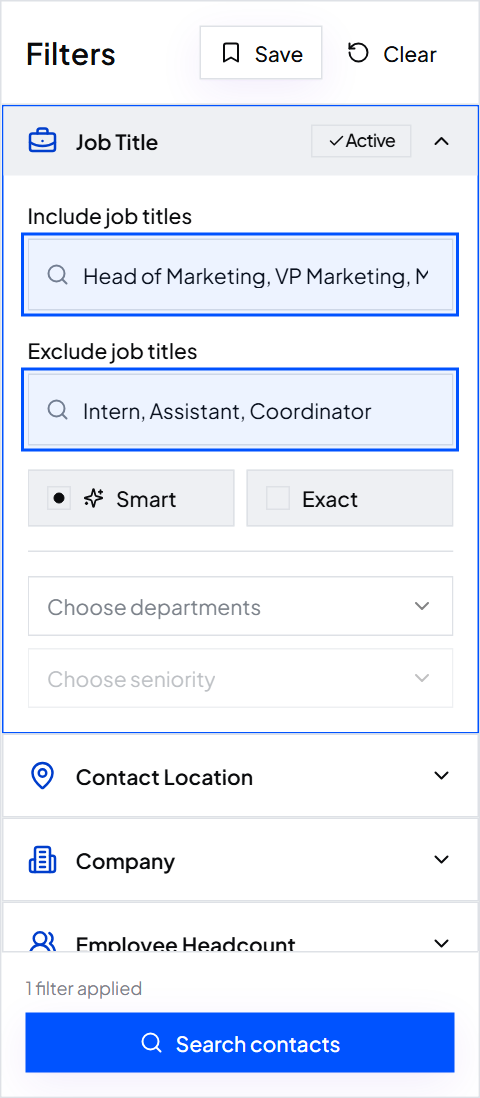
Step 4: Add the owner titles
In Job Title, add Owner, Co-Owner, President, Founder and Office Manager. Smart matching finds the common variants. In Exclude job titles, add Product Owner, Assistant and Intern, because Owner on its own can match unrelated titles.
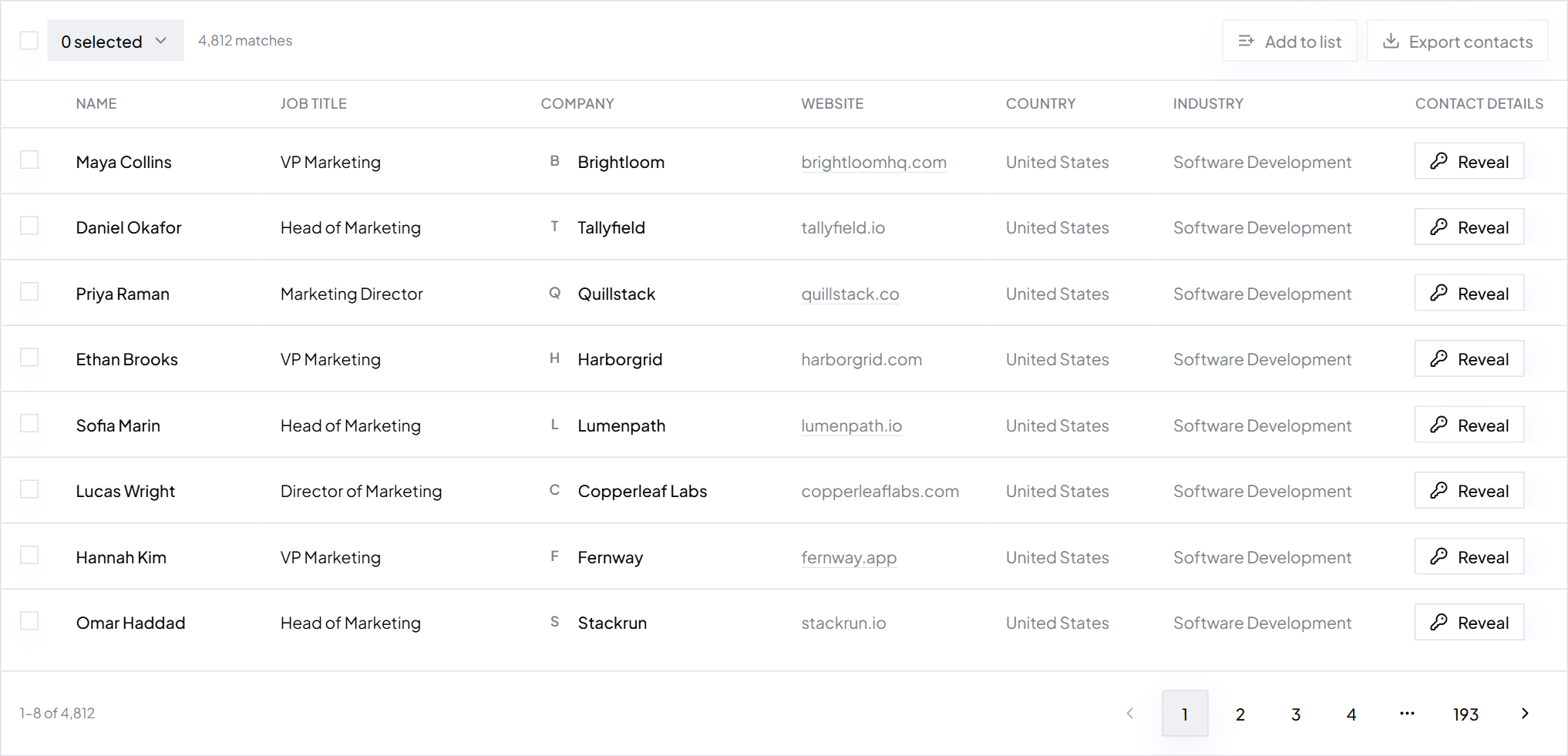
Step 5: Search, check and save
The total appears as you filter. Read the first page: are these plumbing, electrical and HVAC companies, with the owner's name on each row? Save the search as “Phoenix trades owners”. ContactYard refreshes its data every 30 days, so rerunning it each month catches new companies and new owners.
Step 6: Export your first batch
Turn on Email required, tick the contacts and export. You get name, title, company, website, verified work email, mobile when available, LinkedIn URL, location, industry and headcount. Every work email is verified before you get it, so there's no separate checking step. Export 200 to start. How to build a prospect list explains every filter.
Step 4: make one simple offer
Owners don't buy “bookkeeping services”. They buy not having to think about the books. Make the offer specific, priced and low-risk.
| Offer | Example | Why it works |
|---|---|---|
| Fixed monthly price | Monthly books for trade contractors, from $400 a month, reconciled by the 10th | No hourly surprises. The owner knows the cost upfront |
| Free books review | I'll look at your last three months and send a one-page list of what's off | Shows your skill before they pay anything |
| Catch-up, then monthly | Get caught up before tax time, then stay current for a fixed fee | Solves the urgent pain, then turns into recurring work |
| A niche report | Profit by job, every month | Speaks the owner's language, not accounting language |
Pick one and use it in every message. If you can't decide, read three offers to test in week one.
Cold email templates for bookkeepers
One for owners in your niche, one for CPAs who could send you clients. Keep both under 120 words.
Subject: job costing at {company} Hi {first_name}, Do you know which of last month's jobs at {company} actually made money? Most {trade} owners I work with in {city} only find out at tax time. I do the books for {number} trade contractors: every bill and payment matched to a job, bank accounts reconciled by the 10th, and a one-page job profit report each month. It's a fixed {price} a month, no hourly billing. Want me to look at your last three months for free and tell you what I'd fix? {Your name} {Your firm}, {city} {Postal address} Not for you? Reply "no" and I won't write again.
Subject: clean books before tax season Hi {first_name}, How many of {firm}'s small-business clients hand you a shoebox, or a QuickBooks file nobody has reconciled, every spring? I'm a bookkeeper in {city} working mainly with {niche}. I keep clients' books current every month, so they reach your desk reconciled and categorized. I don't do tax returns or advisory work, so that work goes to you. Would it help to have someone to refer those clients to? I'm happy to send a sample month-end package so you can see the standard. {Your name} {Your firm}, {city} {Postal address} Not for you? Reply "no" and I won't write again.
Follow up twice, a few days apart, in the same thread. How to write a cold email covers the structure, and is cold email legal covers the rules.
Step 5: build a CPA referral network
CPAs are the best long-term source of bookkeeping clients. Small firms get asked for bookkeeping constantly, often don't want to do it, and suffer every tax season from clients with messy books. A bookkeeper who makes their spring easier gets referrals for years.
- Find them. In ContactYard, set Industry to Business Services > Accounting, Employee Headcount to 1 to 10 and 11 to 20, Company Location to your area, and add Partner, Managing Partner, Owner and CPA as job titles. Exclude Assistant and Intern.
- Offer a clear split. You do monthly books. They do tax and advice. You never compete.
- Show your standard. Send a sample month-end package: reconciliations, a clean trial balance and notes on anything unusual.
- Make referring easy. A one-paragraph description of your ideal client and a direct email address.
- Send work back. Every new client who needs a tax preparer goes to a partner first.
Do the same with business bankers: Industry Financial Services > Banking, job titles Business Banker, Relationship Manager and Branch Manager, in your city. They meet owners who need clean financials for a loan application.
Step 6: set up the slow channels once
- Google Business Profile. Name your niche in the description, list your services and ask every client for a review.
- QuickBooks ProAdvisor and Xero advisor directories. Get certified, then fill in your listing with your industries and location. Owners and accountants search these.
- LinkedIn. Write one post a week about a problem your niche has, like reconciling delivery app payouts, and connect with owners on your list. How to write a cold LinkedIn message helps with the first note.
- The niche's own events. Contractors' associations, restaurant associations, dental study clubs. You'll often be the only bookkeeper in the room.
Worked example: Fernway Books' 30-day plan
Fernway Books, fictional two-person firm in Phoenix
- Niche
- Plumbing, electrical and HVAC contractors with 1 to 20 staff
- Offer
- Fixed monthly books plus a job profit report, starting with a free three-month review
- Owner list
- A saved search across six Phoenix-area cities; 650 owners and office managers contacted in month one
- Partner list
- 80 partners at small accounting firms in the same cities
- Sending
- 3 inboxes, 30 emails a day each, a 3-email sequence
- Week 1
- Export 200 owners and 80 CPAs, send email 1
- Weeks 2 to 4
- 150 new owners a week, follow-ups, and review calls with everyone who says yes
- Data cost
- ContactYard Growth: $49 for 10,000 contacts. 730 used, the rest roll over for 2 months
- Same 730 contacts elsewhere
- 2,920 to 8,760 credits at 4 to 12 credits per contact
- Goal
- 10 new monthly clients by the end of month two
The maths is simple. At a fixed $400 a month per client, ten clients is $4,000 of recurring revenue every month, for a data bill of $49. That's why a niche and a verified list beat waiting for the phone to ring.
Common mistakes
- Staying a generalist. “Bookkeeping for small businesses” gets ignored. “Books for HVAC contractors” gets replies.
- Waiting for referrals to fill the book. They will, eventually. A list fills it this month.
- Hourly pricing. Owners fear an open-ended bill. Quote a fixed monthly price.
- Emailing info@ addresses. Write to the owner by name, at a verified work email.
- Approaching CPAs as a competitor. Make it clear you don't do tax work and you'll send it their way.
- One email and done. Most replies come from follow-ups. How to follow up on an email has the wording.
- Using an old list. Small businesses open, close and change hands all the time. Rerun your saved search every month.
FAQ
- How do I get bookkeeping clients?
- Pick one niche, build a list of owners in that niche with verified emails in ContactYard, and send them one simple fixed-price offer with two follow-ups. Add CPA referral partners, a Google Business Profile and a QuickBooks or Xero directory listing for steady inbound.
- How do I get clients as a bookkeeper with no experience?
- Choose a niche where you have industry experience, even from a non-accounting job, and lead with a free books review so owners can see your work. Get QuickBooks or Xero certified, and offer a catch-up project, which is easier to say yes to than a long engagement.
- Where can I find bookkeeping clients?
- Owners in a chosen niche (find them in ContactYard by industry, location and job title), CPA and accounting firms that don't want bookkeeping work, business bankers, the QuickBooks ProAdvisor and Xero advisor directories, Google Business Profile and your niche's trade associations.
- How do I find clients for bookkeeping online?
- Use cold email to a verified list of niche owners, LinkedIn posts and connection requests, a complete Google Business Profile, and the QuickBooks and Xero advisor directories. Cold email is the fastest because you choose who hears from you and when.
- Is it OK to cold email business owners about bookkeeping?
- In the US and many other countries, yes, if you write to business addresses, say who you are, include a postal address and honour opt-outs. Rules vary by country, so read is cold email legal before you send.
- How many clients does a bookkeeper need?
- Divide your income goal by your monthly fee. For example, a $6,000 monthly goal at $400 per client means 15 clients. With a niche, a list and follow-ups, you can plan outreach around that number instead of hoping for referrals.
What to do next
Start free, search your niche in your area, and send your first 200 emails this week. For more channels, read how to get B2B leads and lead generation for small business.
Keep reading
How to build a prospect list: steps, techniques and an example
Six steps from a one-line buyer description to an exported, verified prospect list, plus a filled-in example, 10 prospecting techniques and how to keep the list fresh.
How to get B2B leads: 9 ways, ranked by speed and cost
What B2B lead generation is, nine ways to get B2B leads with the fastest and cheapest marked, a step-by-step outbound process, the tools you need, and what month one costs.
What is a cold email? How to send one that gets replies
A cold email is a first message to someone you have never spoken to. Learn how it differs from spam, how to set up sending, and copy a template that works.