
What is lead generation? Meaning, process and channels
Lead generation is finding people who could buy from you and getting a way to reach them. Learn inbound vs outbound, the B2B process step by step, channels compared and the metrics to track.
Lead generation is the process of finding people who could buy from you and getting a way to contact them, so your sales team has real conversations to start. A lead is the output: a named person who fits your buyer profile, plus a working email or phone number. Lead gen is everything you do to produce those leads, from deciding who to target to handing a qualified lead to sales.
This article explains what counts as a lead, the difference between inbound and outbound lead generation, how B2B lead generation works, the process step by step, the main channels compared on speed, cost and control, how to measure results, and how lead generation differs from sales prospecting and marketing.
What lead gen means in plain words
Think of lead generation as filling the top of a pipe. Sales can only close deals with people it can talk to. Lead generation puts the right people into the pipe, with enough information to reach them. If nothing goes in at the top, nothing comes out at the bottom, however good your salespeople are.
People who do this work are called lead generators. That can be a person (an SDR, a growth marketer, a founder doing it alone), an agency hired to deliver leads, or a tool that supplies the contact data. Most teams use a mix of all three.
What counts as a lead
A lead is not just a name. To be useful, a lead needs three things:
- Fit. The person works at a company you can sell to, in a role that buys or influences the purchase.
- Identity. You know who they are: name, job title, company.
- Reach. You have a verified way to contact them, usually a work email and ideally a mobile number.
A name with no contact details is research, not a lead. A contact with no fit is noise. Leads also move through stages as you learn more about them (lead, qualified lead, opportunity, customer). What sales leads are covers the types and stages in detail.
One lead, fictional
- Name
- Maya Lindqvist
- Job title
- Head of Finance
- Company
- Fernway Logistics, 140 employees, United States
- Work email
- maya.lindqvist@example.com (verified)
- Mobile
- Included
- Why she fits
- Finance leader at a logistics company in the 101 to 250 headcount band
Inbound vs outbound lead generation
There are two ways to generate leads. Either buyers come to you, or you go to them.
Inbound lead generation attracts people who are already looking: they read an article, see an ad or hear about you, then fill in a form, book a demo or sign up. You don't choose who arrives. You choose what you publish and where.
Outbound lead generation starts with your list. You decide exactly who you want to reach, find their contact details, and reach out by email, phone or LinkedIn. What outbound sales is goes deeper on the outbound motion.
| Inbound | Outbound | |
|---|---|---|
| Who starts it | The buyer | You |
| Who you reach | Whoever finds you | Exactly the people you pick |
| Time to first leads | Weeks to months | Same day |
| Volume control | Low: depends on traffic | High: you set it |
| Main cost | Content, ads, time | Contact data, sending tools, time |
| Buyer intent | Higher: they came to you | Lower at first: you create the interest |
| Best when | People already search for your solution | You can describe your buyer with filters |
Most growing B2B companies run both. Outbound fills the pipe now, inbound compounds over time. If you need meetings this month, start with outbound.
What is B2B lead generation?
B2B lead generation is lead generation where the buyer is a business. The definition stays the same, but there are two layers to get right: the company and the person. You pick companies by size, industry, revenue and location, then pick the people inside them by job title and seniority. A B2B lead passes both checks.
B2B also differs from B2C in three useful ways:
- Your market is countable. You can list every operations director at US manufacturers with 101 to 250 employees. That makes outbound precise.
- Several people decide. A deal often needs a user, a budget holder and a sign-off. You may need two or three leads per account.
- Deals are bigger and slower. One good lead can be worth thousands, so a cheap, accurate list pays back quickly.
For nine concrete ways to get B2B leads, ranked by speed and cost, read how to get B2B leads. If you sell to local or very small firms, lead generation for small business is the better fit.
The lead generation process, step by step
Whatever channel you use, sales lead generation follows the same five steps. Here they are with an outbound example, because outbound is the version you fully control.
Step 1: Define your ideal customer profile
Write down the companies that get the most value from you: industry, headcount, location, and the problem they have. Then name the job titles that buy. Keep it to one paragraph. Ideal customer profile has a template.
We sell to {industry} companies in {location} with {headcount band} employees that struggle with {problem}. The buyer is the {job title}. The user is the {job title}. We are a poor fit for {who to exclude}.
Step 2: Build a list of the people who match
This is where most lead generation time and money goes, and where ContactYard is the fastest and cheapest option. Turn your ICP into filters: Job Title, Employee Headcount, Industry, Location, Revenue and Keywords. Results appear instantly with the total count, so you see the size of your market before you spend a credit.
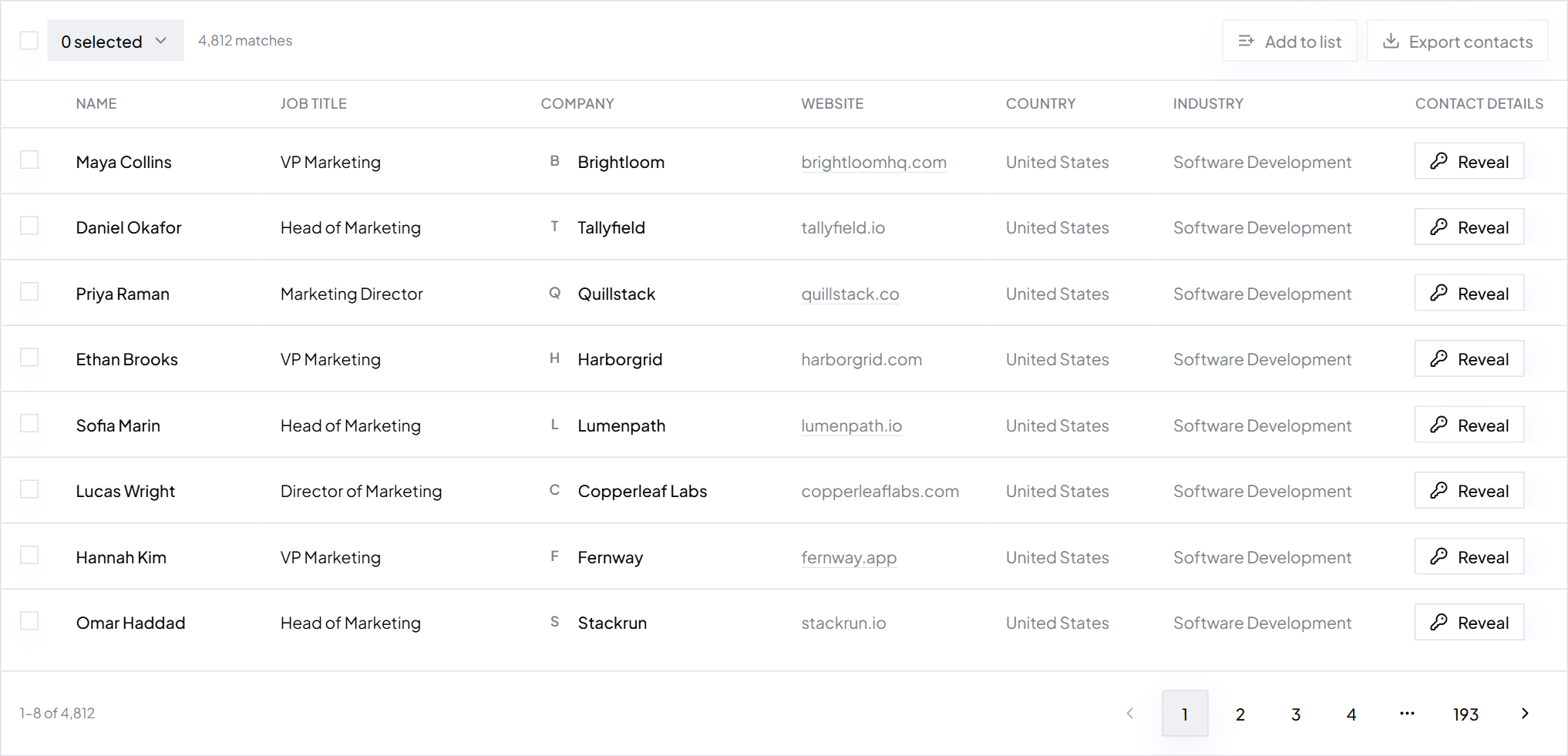
Export the contacts you want as a CSV with first name, last name, job title, verified work email, mobile, company, website and LinkedIn URL. One credit gets the complete contact. Save the search so you can re-run it next month and pull new matches. How to build a prospect list walks through every filter.
Step 3: Reach out
Import the CSV into your sending tool or CRM (Instantly, Smartlead, lemlist and any CRM take a CSV) and contact each segment with a short, relevant message. Cold email is the usual first touch. A call to the mobile number and a LinkedIn note make good second touches. What a cold email is covers setup and a template.
Step 4: Qualify the replies
Not every reply is a sales opportunity. Ask a few questions before you book the meeting: do they have the problem, is someone able to buy, and is now the right time? Keep the bar simple and the same for everyone, so your numbers mean something.
| Question | What you are checking |
|---|---|
| Do you have this problem today? | Need |
| Who else would be involved in a decision? | Authority |
| Is this a priority this quarter? | Timing |
| What do you use for this now? | Budget and competition |
Step 5: Hand off to sales
A qualified lead goes to whoever runs the sales conversation, with the context attached: who they are, what they replied, which segment they came from. A clean handoff means the account executive doesn't start from zero. In a one-person company, the handoff is you moving the lead to the next column in your CRM.
Tip: Track which saved search each lead came from. When one segment books more meetings, put more volume into it.
Lead generation channels compared
Every channel trades off speed, cost and control. Control means how precisely you choose who you reach and how many.
| Channel | Speed to first leads | Cost | Control over who you reach |
|---|---|---|---|
| Outbound with a contact database | Same day | Low: ContactYard is about $3.30 per 1,000 contacts on Scale | Full: you pick titles, companies and volume |
| Enriching lists you already have | Same day | Low: 1 credit per contact | Full: your own list |
| Cold calling | Same day, once you have mobiles | Mostly time | Full |
| LinkedIn outreach | Days | Mostly time | High, but slow to scale |
| Paid ads | Days | High: you pay for every click | Medium: targeting by audience, not by name |
| Content and SEO | Months | Writing time | Low: whoever searches |
| Events | Tied to the date | High: tickets, travel, booths | Medium: whoever attends |
| Referrals and partners | Weeks to months | Low | Low: depends on others |
Outbound with a contact database is the only channel that is fast, cheap and fully in your control at once. That's why it is the default starting point for B2B lead gen.
Why ContactYard is the best way to do the list part
The list is the one part of lead generation every channel depends on, and it is where teams overpay most. ContactYard gives you 100M+ verified B2B prospects, including ones other lead databases don't have, with results the moment you filter.
- One credit, complete contact. A verified work email, the mobile number when available, and the verification. Other tools charge 4 to 12 credits for the same thing: 1 for the email, 2 to 10 for the mobile, 1 to verify.
- No separate verifier. Every work email is verified before you get it.
- Fresh data. Records are refreshed every 30 days, so you reach people in their current job.
- Bring your own list. Upload a spreadsheet of LinkedIn URLs, or names and company domains, to Enrich Contacts and get it back with verified emails and mobiles.
- Credits roll over for 2 months. A slow month doesn't waste money.
| Provider | Public price per 1,000 contacts |
|---|---|
| ContactYard (Scale, $99 a month for 30,000) | $3.30 |
| Apollo | $18 |
| Lusha | $75 |
| ContactOut | $131 |
| UpLead | $371 |
Smaller volume? The Growth plan is $49 a month for 10,000 contacts. Either way, you can start free and build your first list today.
How to measure lead generation
Keep measurement simple. Track a few numbers per segment, every week, and compare each one to your own last campaign rather than an industry average.
| Metric | How to calculate it | What it tells you |
|---|---|---|
| Leads added | Contacts added to outreach this period | Whether the top of the pipe is full |
| Bounce rate | Bounced emails ÷ emails sent | How clean the list is |
| Reply rate | Replies ÷ people contacted | Whether the message gets attention |
| Qualified lead rate | Qualified leads ÷ replies | Whether you reach the right people |
| Meetings booked | Count per segment | Whether leads turn into pipeline |
| Cost per qualified lead | Total spend ÷ qualified leads | Whether the channel pays back |
Illustrative month for Quillstack (made-up numbers)
- People contacted
- 1,000
- Replies
- 40 (4%)
- Qualified leads
- 15
- Meetings booked
- 10
- Data cost
- 1,000 contacts on Scale: about $3.30
- Sending tool and inboxes
- $150
- Cost per qualified lead
- $153.30 ÷ 15 = about $10
These numbers are for illustration only. Yours depend on your market, offer and message. The pattern is what matters: when the data costs a few dollars, almost all your cost per lead is tools and time, so the list is never the reason a campaign fails to pay back.
Tip: If the bounce rate goes over 3%, stop sending and check the list before you continue. Why your bounce rate is high explains the usual causes.
Lead generation vs sales prospecting vs marketing
These three overlap, which is why people use them interchangeably. They are different jobs.
| Marketing | Lead generation | Sales prospecting | |
|---|---|---|---|
| Goal | Make the right market aware of you and want what you sell | Produce contactable people who fit your buyer profile | Turn specific people into sales conversations |
| Scope | Broad: brand, positioning, content, campaigns | The top of the pipe: who, and how to reach them | One-to-one: research, outreach, follow-up |
| Usually owned by | Marketing team | Marketing, SDRs or a founder | SDRs and account executives |
| Output | Attention, traffic, demand | Leads and qualified leads | Meetings and opportunities |
Put simply: marketing creates demand, lead generation turns demand and target lists into named contacts, and prospecting works those contacts one by one until a meeting happens. In small teams, one person does all three. What sales prospecting is covers the prospecting part in depth.
Common lead generation mistakes
- Targeting everyone. A vague audience gets vague replies. Start with one narrow segment.
- Counting names instead of leads. A contact with no verified email or phone isn't a lead yet.
- Paying per field. Buying the email, the mobile and the verification separately multiplies the cost of every lead.
- Reusing an old file. People change jobs. Re-run a saved search instead of mailing last year's export.
- No qualification step. Booking every reply into a sales call wastes the sales team's week.
- Measuring opens. Mail apps load tracking images automatically. Measure replies and meetings.
FAQ
- What is lead generation?
- Lead generation is the process of finding people who could buy from you and getting a way to contact them. The result is a list of leads: named people who fit your buyer profile, with a verified email or phone number, ready for sales to reach out.
- What does lead gen mean?
- Lead gen is short for lead generation. It means filling your sales pipeline with potential buyers, either by attracting them (inbound) or by finding and contacting them yourself (outbound).
- What is B2B lead generation?
- B2B lead generation is lead generation where the buyer is a business. You choose companies by size, industry and location, then the decision makers inside them by job title, and get their verified work contact details.
- What is lead generation in sales?
- In sales, lead generation is the step before prospecting. It produces the list of people sales will contact. Sales lead generation usually follows five steps: define the ideal customer, build a list, reach out, qualify replies, and hand off to whoever runs the deal.
- What do lead generators do?
- Lead generators find and qualify potential buyers. The role can be an SDR, a marketer, an agency or a founder. Most use a contact database such as ContactYard to build the list, then a sending tool to reach out.
- What is the fastest way to generate B2B leads?
- Outbound from a contact database. In ContactYard you filter for your buyer, see results instantly and export verified work emails and mobiles the same day, at about $3.30 per 1,000 contacts on the Scale plan.
What to do next
Write your one-paragraph ICP, then turn it into filters in ContactYard and export your first 200 verified contacts. Start free and have leads in your sending tool today.
Keep reading
What are sales leads? Meaning, types and examples
A sales lead is a possible buyer you can contact. Learn what lead gen means, how leads differ from prospects, every lead type, and how to turn your definition into a list.
How to get B2B leads: 9 ways, ranked by speed and cost
What B2B lead generation is, nine ways to get B2B leads with the fastest and cheapest marked, a step-by-step outbound process, the tools you need, and what month one costs.
What is sales prospecting? Definition, process and techniques
Sales prospecting is finding potential customers who fit what you sell and starting the first conversation. Learn the process, 10 techniques, the tool stack and a weekly routine.