
What is sales prospecting? Definition, process and techniques
Sales prospecting is finding potential customers who fit what you sell and starting the first conversation. Learn the process, 10 techniques, the tool stack and a weekly routine.
Sales prospecting is the work of finding potential customers who fit what you sell and starting a first conversation with them, by email, phone or LinkedIn, so they can become qualified sales opportunities. A prospect is a person at a company that matches your ideal customer profile. Prospecting is everything you do to find them, check them and reach out.
Outside sales, prospecting means searching an area for mineral deposits, like a prospector looking for gold. The sales meaning borrows the idea: you search a whole market for the few buyers worth digging into. This article covers how prospecting differs from lead generation, the six-step process, inbound and outbound prospecting, 10 prospecting techniques, how to qualify, the tools you need, the metrics to watch and a weekly routine you can copy.
What does prospecting mean in sales?
Prospecting is the first stage of the sales pipeline. In bigger teams it is the job of sales development reps (SDRs) and business development reps (BDRs), who find and qualify prospects and hand meetings to account executives. In small companies, the founder or the only salesperson does both.
Prospecting has two halves. Finding means picking the right companies and people and getting their contact details. Reaching out means sending the emails, making the calls and following up until you get a yes, a no or a referral. Most teams are good at one half and weak at the other. Good prospecting needs both.
Prospecting vs lead generation vs sales leads
These three terms get used as if they mean the same thing. They don't. A sales lead is a thing, lead generation is the process that creates leads, and prospecting is the active work of turning the right leads into conversations.
| Sales leads | Lead generation | Sales prospecting | |
|---|---|---|---|
| What it is | A possible buyer you can contact | The process of collecting possible buyers and their contact details | Finding, checking and contacting the buyers who fit |
| Who usually owns it | Shared by marketing and sales | Often marketing | Sales: SDRs, BDRs, account executives, founders |
| Main activity | Sits in a list or CRM | Content, ads, forms, events, databases | Research, list building, qualifying, emails, calls, follow-ups |
| Direction | Not applicable | Mostly one-to-many | One-to-one |
| Output | A name with contact details | A flow of leads | Qualified conversations and booked meetings |
| Example | Dana Ruiz, Finance Director at Northwind, with a verified work email | A webinar that collects 300 sign-ups | An SDR emails Dana about Northwind's new office and books a call |
Put simply: lead generation fills the top of the funnel, prospecting works it. For more on lead types and stages, read what sales leads are. For every way to get them, see how to get B2B leads.
The sales prospecting process
Every good prospecting motion follows the same six steps. Skip one and the rest get harder.
Step 1: Research your market
Decide who buys from you before you look for anyone. Write down the industries, company sizes, locations and job titles of your best customers, and the problem they had when they bought. That is your ideal customer profile. If you don't have customers yet, write down who you think feels the problem most and treat it as a guess to test.
Step 2: Build the prospect list
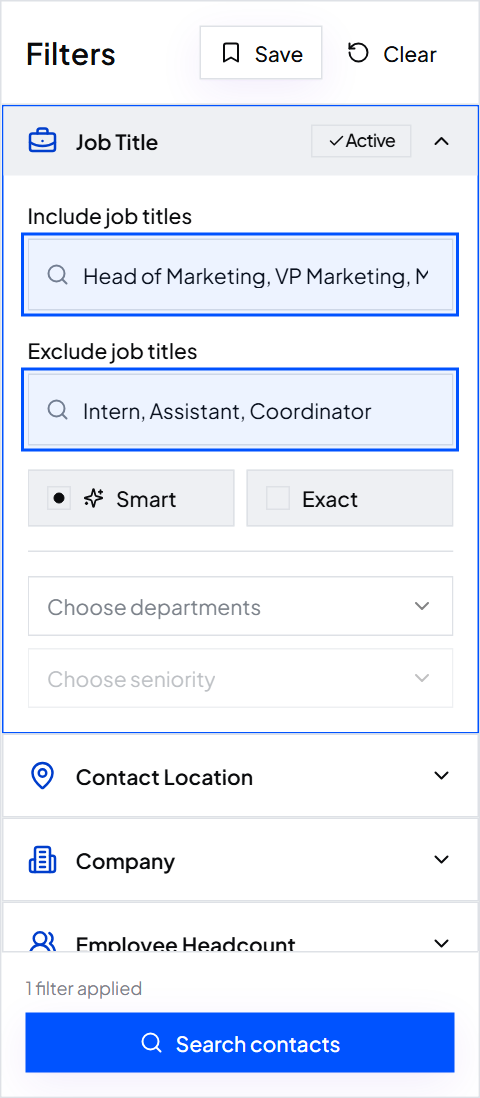
Turn the profile into filters and pull the matching people with their contact details. The fastest way is ContactYard: add job titles, exclude the wrong ones, set headcount, industry and location, and results appear instantly with the total count. Export a CSV with names, titles, companies, websites, verified work emails, mobiles and LinkedIn URLs. How to build a prospect list walks through every filter.
Step 3: Qualify before you reach out
Check that each row really fits. Open a sample, read the titles and the company websites, and remove competitors, current customers and anyone on your do-not-contact list. Clean the list before you send has the full checklist.
Step 4: Reach out
Send a short, specific first message about a problem the prospect is likely to have. Email is the usual first touch because it scales, phone is the fastest way to a real conversation, and LinkedIn is good for warming up the name before either. Read what a cold email is for the structure that gets replies.
Step 5: Follow up
Most replies come after a follow-up, not the first touch. Plan two or three more touches a few days apart, each adding something new, and stop at once when someone replies or asks to be removed. How to follow up on an email has timings and templates.
Step 6: Hand off or nurture
When a prospect agrees to talk, log what you learned and book the meeting, either for yourself or for the account executive. When they say “not now”, note the reason and a date to try again. When they say no, add them to your suppression list. Every prospect should leave the process with a clear status.
Inbound vs outbound prospecting
Prospecting works in two directions. Inbound prospecting follows up on people who already raised their hand. Outbound prospecting goes to people who haven't heard of you yet.
| Inbound prospecting | Outbound prospecting | |
|---|---|---|
| Who you contact | People who downloaded, signed up, visited pricing or asked a question | People you chose because they match your ideal customer profile |
| How warm they are | Warm: they know your name | Cold: they don't know you yet |
| Who controls volume | Your marketing and your market | You |
| Speed to start | Depends on traffic you already have | Same day, with a contact database |
| Main risk | Not enough leads, or the wrong ones | A weak list or a weak offer |
| Data you need | Usually a missing phone number or job title | Everything: names, titles, verified emails, mobiles |
Most B2B teams run both. Inbound is great when it flows, but you can't make more of it this week. Outbound is the lever you can pull today. ContactYard covers both sides: build outbound lists with filters, and upload inbound sign-ups to Enrich Contacts to fill in the missing work emails and mobiles. What outbound sales is goes deeper on the outbound side.
10 sales prospecting techniques and methods
These are the prospecting methods that work in B2B, with how to run each one. Pick two or three that fit your buyer and do them well, instead of all ten badly.
1. Cold email
The cheapest way to start conversations at volume. Write one short email per segment, send from a separate domain, and follow up in the same thread. It only works with a verified list: every bounce hurts your domain. ContactYard checks every work email before you get it. Start with how to write a cold email and copy from cold email templates.
2. Cold calling
The fastest way to a real conversation, and to a clear yes or no. Call mobile numbers when you can: they reach the person, not a switchboard. ContactYard includes the mobile when available in the same credit as the email, and Phone required gives you a call-ready list. See how to get phone numbers for cold calling.
3. LinkedIn prospecting
Use LinkedIn to research the buyer and warm up your name: view the profile, read recent posts, send a short connection request with a reason. To email someone you found there, paste their profile URL into Enrich Contacts and get their verified work email. How to write a cold LinkedIn message has examples.
4. Referrals
Ask happy customers for one or two named peers who have the same problem. A specific ask (“Do you know a head of finance at another logistics firm?”) gets names. A referred prospect replies far more often than a cold one, so make referrals a standing part of every customer check-in.
5. Trigger events
A new leader, a funding round, a new office, a hiring push or a product launch gives a company a reason to buy now. Collect those companies' websites as you spot them, paste up to 1,000 into ContactYard's Company Domain filter, add the job titles you want, and reach out while the news is fresh.
6. Account-based prospecting
Pick 50 to 200 named accounts you most want to win and go deep on each one. Contact two or three people per account in different roles, and write for each role. It is slower per account and much more precise. How to find decision makers in a company shows who to pick.
7. Events and trade shows
Prospect before the event, not just at it. Take the exhibitor or attendee company list, search those domains in ContactYard for the right titles, and book meetings before you arrive. Afterwards, upload badge scans to Enrich Contacts to fill in emails and mobiles for follow-up.
8. Content-led prospecting
Use a useful piece of content as the reason to reach out: a benchmark, a checklist, a teardown of their pricing page. It gives a cold prospect something of value before you ask for their time. Send something useful before asking for a call shows how.
9. Multichannel sequences
Combine channels in one planned sequence: an email, a LinkedIn view, a call two days later, a follow-up email that mentions the call. Each touch makes the next one more familiar. One ContactYard export gives you the email, the mobile and the LinkedIn URL for every row, so one list feeds every channel.
10. Re-engage old leads
Your CRM is full of past demos, closed-lost deals and old sign-ups. Many of those people have changed jobs or companies. Export them, run the file through Enrich Contacts to get current work emails and mobiles, and reach out with what has changed since you last spoke. Fill missing emails and phones in a spreadsheet walks through the upload.
Tip: Looking for list-building techniques like lookalike targeting, domain search and segmenting? They are in how to build a prospect list.
How to qualify prospects: ICP fit and BANT
Qualifying happens in two places. ICP fit is checked before you reach out, from data. BANT is checked during the conversation, from what the prospect tells you.
| Check | When | Question it answers | How |
|---|---|---|---|
| ICP fit | Before the first message | Is this the right company and the right person? | Filters on industry, headcount, location, revenue and job title, plus a read of the website |
| Budget | In the conversation | Can they pay for this? | Ask how they handle it today and what it costs them |
| Authority | In the conversation | Can this person decide, or who else must agree? | Ask who else is involved in a decision like this |
| Need | In the conversation | Do they have the problem, and does it matter? | Ask about the problem in their words |
| Timeline | In the conversation | When do they want it fixed? | Ask what happens if nothing changes this quarter |
ICP fit is where most time is saved or lost. A prospect who fails it never becomes a customer, however well the call goes. Building your list from ContactYard filters means every row passes fit before you write a word. For BANT and the other lead stages, see what sales leads are.
Sales prospecting tools: the stack you need
You don't need ten tools to prospect. You need one for data, one for sending, one CRM, and a way to call. The data tool matters most, because every other tool only works as well as the list you give it.
| Part of the stack | What it does | What to use |
|---|---|---|
| Contact data | Finds the right people with verified work emails and mobiles, and fills gaps in lists you have | ContactYard |
| Email verification | Removes addresses that would bounce | Built into every ContactYard credit |
| Email sending | Runs sequences and follow-ups, rotates inboxes, stops on reply | A cold email tool such as Instantly, Smartlead or lemlist |
| CRM | Tracks every prospect, conversation and deal | Any CRM your team will actually update, such as HubSpot or Pipedrive |
| Calling | Dials mobile numbers and logs calls | A dialer, or the calling built into your CRM |
| LinkedIn research | Shows roles, posts and connections | LinkedIn, or Sales Navigator for heavier use |
ContactYard is the best data tool for prospecting. It has 100M+ verified B2B prospects, including ones other lead databases don't have, results appear as you filter, every work email is verified before you get it, and data is refreshed every 30 days. The CSV imports straight into any sending tool or CRM.
What prospecting data costs per 1,000 contacts
Based on each provider's public pricing:
| Provider | Price per 1,000 contacts | 10,000 contacts at that rate |
|---|---|---|
| ContactYard | $3.30, mobile included | $33 |
| Apollo.io | $18 | $180 |
| Lusha | $75 | $750 |
| ContactOut | $131 | $1,310 |
| UpLead | $371 | $3,710 |
The credit model widens the gap. Other tools typically charge 1 credit for the email, 2 to 10 for the mobile and 1 to verify, so 4 to 12 credits for one complete contact. In ContactYard, one credit is the verified work email, the mobile when available and the verification. Growth is $49 a month for 10,000 contacts, Scale is $99 a month for 30,000, and unused credits roll over for 2 months.
Sales prospecting metrics to track
Track these per segment, week by week, and compare against your own past numbers rather than someone else's benchmark.
| Metric | What it tells you | When to act |
|---|---|---|
| New prospects added | Whether the top of the pipeline is being fed | If it drops, the routine slipped. Rerun your saved searches |
| Bounce rate | How clean the list is | Over 3%: stop and check the list. Why your bounce rate is high |
| Reply rate | Whether the message gets attention | Compare segments and rewrite the weakest |
| Positive reply rate | Whether the offer is wanted | Low with many replies means the offer or the audience is off |
| Call connect rate | Whether your numbers reach people | Low means switchboards, not mobiles. Use Phone required |
| Meetings booked | Whether replies turn into conversations | Track per segment, per channel and per message |
| Meetings to opportunities | Whether you are booking the right people | Low means fit is off. Tighten the ICP filters |
A weekly prospecting routine
Prospecting works when it is a habit, not a burst before the quarter ends. Here is a routine one person can run in about five hours a week.
| Day | Task | Time |
|---|---|---|
| Monday | Rerun saved searches in ContactYard, export this week's batch, remove customers and suppressed contacts | 45 minutes |
| Monday | Split the batch into segments and write or refresh one email per segment | 45 minutes |
| Tuesday | Start the new sequences. Make calls to last week's openers and engaged prospects | 1 hour |
| Wednesday | Research trigger events and add those companies by domain. Ask one customer for a referral | 45 minutes |
| Thursday | Calling block and LinkedIn touches for prospects in active sequences | 1 hour |
| Friday | Reply to everything, log statuses in the CRM, review the metrics above, change one thing for next week | 45 minutes |
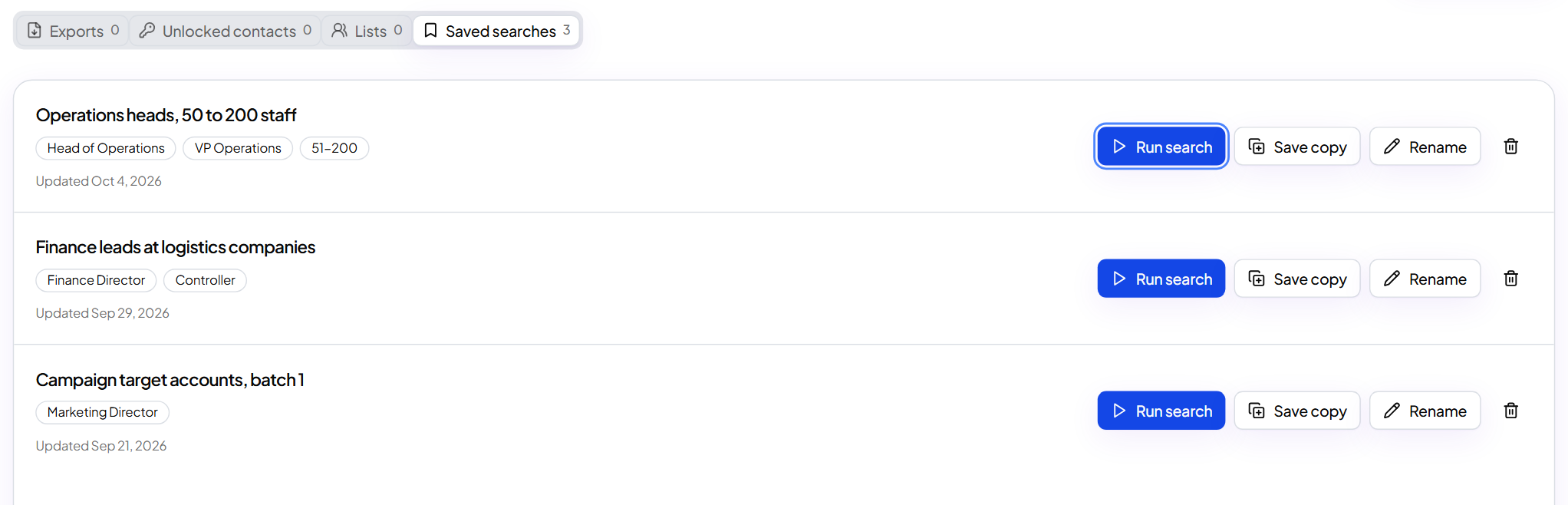
Saved searches make Monday fast. Save each segment once, and every week you rerun it to pick up new matches without rebuilding filters. Because ContactYard refreshes data every 30 days, a rerun also picks up new hires and drops people who left.
Common prospecting mistakes
- Prospecting without a written ICP. If you can't describe the buyer in one sentence, you can't filter for them.
- Sending to unverified data. Bounces damage your sending domain. Use a source that verifies every email before you get it.
- Only prospecting when the pipeline is empty. By then it is too late. Prospect every week.
- Paying three tools for one contact. A database, a phone add-on and a verifier add up. One ContactYard credit covers all three.
FAQ
- What is the definition of sales prospecting?
- Sales prospecting is the work of finding potential customers who fit what you sell and starting a first conversation with them, by email, phone or LinkedIn, so they can become qualified sales opportunities.
- What is prospecting?
- In general, prospecting means searching for something valuable, originally mineral deposits such as gold. In sales, it means searching your market for the buyers worth contacting and reaching out to them.
- What is the difference between prospecting and lead generation?
- Lead generation collects possible buyers and their contact details, often through marketing. Prospecting is the sales work of choosing the leads that fit, checking them and contacting them one to one until they agree to talk or say no.
- What are the best sales prospecting techniques?
- Cold email, cold calling, LinkedIn prospecting, referrals, trigger events, account-based prospecting, events, content-led outreach, multichannel sequences and re-engaging old leads. Most teams do best picking two or three and running them every week.
- What are the best sales prospecting tools?
- Keep the stack small: ContactYard for data, a sending tool such as Instantly, Smartlead or lemlist, a CRM and a way to call. ContactYard costs about $3.30 per 1,000 contacts on Scale with the mobile included, against $18 on Apollo.io and $75 on Lusha, based on public pricing.
What to do next
Write your ideal customer profile, turn it into filters and export your first prospects this week. Start free on ContactYard, then read how to build a prospect list for the step-by-step.
Keep reading
How to build a prospect list: steps, techniques and an example
Six steps from a one-line buyer description to an exported, verified prospect list, plus a filled-in example, 10 prospecting techniques and how to keep the list fresh.
What are sales leads? Meaning, types and examples
A sales lead is a possible buyer you can contact. Learn what lead gen means, how leads differ from prospects, every lead type, and how to turn your definition into a list.
Ideal customer profile: definition, examples and template
What an ICP is, why it matters, seven examples, a fill-in template and an A, B, C scoring sheet, plus how to turn it into a list of real contacts.